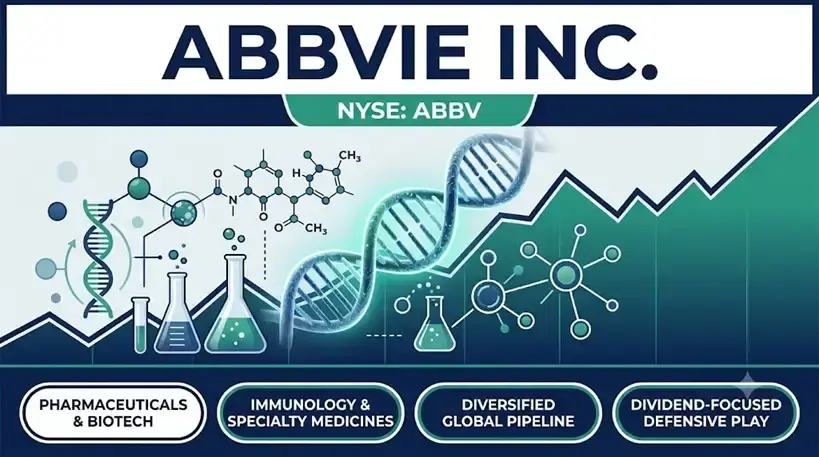
AbbVie Inc. (Ticker: ABBV, NYSE) is a US-listed biopharmaceutical company focused on discovering, developing, manufacturing, and commercializing innovative medicines across immunology, neuroscience, oncology, aesthetics, and other specialty-care areas. The company has evolved from its historical dependence on Humira toward a more diversified portfolio led by Skyrizi and Rinvoq, while neuroscience, aesthetics, oncology, and emerging pipeline assets increasingly contribute to growth.
This article provides an updated share price target for 2026 to 2030, together with an analysis of AbbVie's business fundamentals, revenue drivers, competitive position, financial performance, valuation, risks, technical trends, and long-term investment outlook. The information and market data in this article are updated through September 12, 2026, using the latest available company filings, company announcements, and market data.
1. Quick Investment Summary
Sector Pharmaceuticals & Biotechnology |
Market Position Large-cap global biopharma company with a diversified specialty-medicines portfolio |
Risk Level Moderate to Moderately High |
Best For Long-term investors seeking large-cap healthcare exposure, dividend income, and participation in specialty-medicine growth |
Promoter Holding Not applicable (widely held US public company) |
Key Snapshot Share Price: $257.12 · Market Cap: ~$458.8 billion · 52-Week Range: $190.75–$267.47 · TTM Revenue: ~$64.39 billion · TTM Net Income: ~$6.27 billion · Quarterly Dividend: $1.73/share |
Investor takeaway: AbbVie remains one of the world's largest biopharmaceutical companies, with growth increasingly driven by Skyrizi and Rinvoq as Humira's US and international sales continue to decline following biosimilar competition. Second-quarter 2026 revenue increased 10.2% year over year to $16.99 billion, while adjusted diluted EPS increased 22.9% to $3.65. AbbVie also completed its approximately $10.9 billion acquisition of Apogee Therapeutics in September 2026, strengthening its immunology pipeline. The principal investment considerations are continued Skyrizi/Rinvoq growth, pipeline execution, debt, acquisition spending, patent and pricing risks, and the valuation implied by the current share price. S SEC +1 |
Table of Contents
- Quick Investment Summary
- About AbbVie Inc.
- Business Model & Revenue Streams
- Industry Opportunity & Growth Drivers
- Competitive Position & Moat
- Risks & SWOT Analysis
- Financial & Valuation Analysis
- Technical Analysis (Weekly & Monthly)
- AbbVie Inc. Share Price Target 2026–2030
- Who Should Invest & Who Should Avoid
- Final Investment Verdict
- FAQs
- Disclaimer
2. About AbbVie Inc.
Founded in 2013 and headquartered in North Chicago, Illinois, AbbVie Inc. is a global biopharmaceutical company focused on discovering and delivering innovative medicines for serious and complex diseases. Its major therapeutic areas include immunology, neuroscience, oncology, aesthetics, and other specialty-care markets.
Key Offerings:
- Immunology treatments led by Skyrizi and Rinvoq, while Humira remains a declining legacy product following biosimilar competition
- Neuroscience products including Vraylar, Botox Therapeutic, Ubrelvy, Qulipta, and the emerging Vyalev franchise
- Oncology therapies including Venclexta, Imbruvica, Elahere, and epcoritamab-related products and collaborations
- Aesthetics products including Botox Cosmetic and the Juvederm portfolio through Allergan Aesthetics
AbbVie's current strategy is increasingly centered on replacing Humira-related revenue with growth from Skyrizi, Rinvoq, neuroscience, aesthetics, oncology, and business-development transactions. In 2025, worldwide Skyrizi revenue reached $17.562 billion and Rinvoq revenue reached $8.304 billion, while Humira revenue declined to $4.540 billion. The company completed its acquisition of Apogee Therapeutics on September 3, 2026, adding late-stage immunology assets including zumilokibart and APG273 to its pipeline. S SEC +1
3. Business Model & Revenue Streams
AbbVie operates as a research-driven global biopharmaceutical company. Unlike a traditional industrial business, it does not report a conventional order book. Revenue is primarily generated from prescription medicines and specialty products sold through wholesalers, distributors, healthcare providers, pharmacies, payers, and other channels across the United States and international markets. AbbVie reports its operations as a single global business segment. S SEC +1
Revenue is diversified across therapeutic areas, although the immunology portfolio remains particularly important. Growth increasingly comes from newer products and indications, while mature brands face patent, biosimilar, pricing, and competitive pressures.
💼
Immunology Portfolio
Skyrizi and Rinvoq are now the principal growth engines of AbbVie's immunology business. In the second quarter of 2026, Skyrizi generated $5.505 billion and Rinvoq generated $2.525 billion of worldwide revenue, while Humira generated $756 million. Skyrizi and Rinvoq therefore continue to more than offset the ongoing decline of Humira. S SEC
⚙️
Neuroscience & Specialty Care
Neuroscience is becoming a significant growth contributor through Vraylar, Botox Therapeutic, Ubrelvy, Qulipta, and Vyalev. Second-quarter 2026 worldwide revenue included $1.071 billion from Vraylar, $1.042 billion from Botox Therapeutic, $392 million from Ubrelvy, $350 million from Qulipta, and $256 million from Vyalev. S SEC
🔧
Oncology
Oncology revenue is supported by Venclexta, Imbruvica, Elahere, epcoritamab-related collaboration revenue, and other assets. Venclexta generated $771 million in worldwide revenue in the second quarter of 2026, while Elahere generated $211 million. Imbruvica remains an important franchise but faces ongoing competitive and lifecycle pressure. S SEC
🏛️
Aesthetics & Other Revenue
Allergan Aesthetics contributes revenue through Botox Cosmetic, Juvederm, and other aesthetics products. Second-quarter 2026 worldwide revenue included $728 million from Botox Cosmetic and $245 million from the Juvederm collection. S SEC
Key Revenue Characteristics:
• Strong growth from Skyrizi and Rinvoq
• Increasing contribution from neuroscience products
• Diversification across immunology, oncology, neuroscience and aesthetics
• Significant US and international exposure
• Recurring prescription-drug revenue supported by intellectual-property protection and established commercial infrastructure
• Continued investment in R&D, business development, acquisitions and lifecycle management
Risk & Dependency: AbbVie is less dependent on Humira than it was previously, but revenue remains concentrated in a relatively small number of major products. The success of Skyrizi and Rinvoq, the development and commercialization of neuroscience and oncology assets, and successful integration of acquired pipeline assets are important to sustaining long-term growth.
4. Industry Opportunity & Growth Drivers
The global biopharmaceutical industry continues to benefit from demographic aging, rising chronic-disease prevalence, increasing healthcare spending, advances in biologics and targeted therapies, and continuing innovation in areas such as immunology, oncology, neuroscience, and obesity. For AbbVie, the most company-specific growth opportunity is the continued expansion of Skyrizi and Rinvoq together with growth in neuroscience and the development of new pipeline medicines.
Key Growth Drivers:
- Continued global market-share gains and additional indications for Skyrizi and Rinvoq.
- Growth of neuroscience products including Vraylar, Botox Therapeutic, Ubrelvy, Qulipta and Vyalev.
- Expansion of oncology assets such as Venclexta, Elahere and epcoritamab-related programs.
- Pipeline expansion through acquisitions and licensing transactions, including the completed Apogee acquisition.
- Potential new indications and lifecycle opportunities across existing products.
- Long-term opportunities in obesity and other emerging therapeutic categories where AbbVie is investing in research and manufacturing capabilities.
5. Competitive Position & Moat
AbbVie maintains a strong competitive position through its global commercial infrastructure, established physician and payer relationships, large-scale R&D organization, intellectual-property portfolio, manufacturing capabilities, and experience commercializing blockbuster specialty medicines. Its strategic position has improved as Skyrizi and Rinvoq have demonstrated strong growth and reduced the company's reliance on Humira.
Competitive Advantages:
- Strong immunology franchises led by Skyrizi and Rinvoq, with substantial global growth.
- Established neuroscience and aesthetics franchises that diversify the revenue base.
- Large global commercial organization and established relationships with healthcare providers and payers.
- Significant R&D and business-development capabilities supporting pipeline renewal.
- Strong operating cash generation that supports dividends, R&D and strategic investment.
AbbVie nevertheless faces competition from biosimilars, branded therapies, generics and emerging biotech companies. Humira's loss of exclusivity demonstrates the financial impact that patent and exclusivity changes can have. Future competitive strength will depend on maintaining Skyrizi and Rinvoq growth, successfully developing the pipeline, and converting acquisitions into commercially successful medicines.
6. Risks & SWOT Analysis
✅ Strengths
- Diversified portfolio across immunology, neuroscience, oncology and aesthetics
- Strong growth from Skyrizi and Rinvoq
- Established global commercial and R&D infrastructure
- Strong cash generation and long record of dividend increases
- Growing pipeline supported by acquisitions and internal R&D
⚠️ Risks
- Patent and exclusivity risks affecting major products
- Biosimilar and branded competition
- High absolute debt and negative reported stockholders' equity
- Regulatory, clinical-trial and drug-safety risks
- Execution and integration risks following acquisitions such as Apogee
- Pricing and reimbursement pressure in the United States and international markets
Risk note: Investors should monitor Skyrizi and Rinvoq growth, Humira's remaining decline, pipeline approvals and clinical results, debt levels, acquisition spending, regulatory developments, drug-pricing policy, and the valuation of ABBV shares. The September 2026 Apogee acquisition adds potentially valuable pipeline assets but also increases near-term acquisition-related dilution and execution risk. A AbbVie News Center
7. Financial & Valuation Analysis
📊 Valuation Metrics Snapshot
AbbVie traded at approximately $257.12 on September 11, 2026, giving the company a market capitalization of approximately $458.8 billion. Current market data shows a trailing P/E of roughly 72.6x and a forward P/E of roughly 17.8x. The unusually high trailing GAAP P/E should be interpreted carefully because reported GAAP earnings have been affected by significant non-operating and acquisition-related items. A forward or normalized earnings multiple provides a more useful view of the valuation than the original 108.96x figure. F Finance Charts
| Metric | Value |
|---|---|
| Share Price | $257.12 |
| Market Capitalization | ~$458.8 billion |
| Trailing P/E | ~72.6x |
| Forward P/E | ~17.8x |
| Stockholders' Equity | -$5.935 billion |
| Total Current + Long-Term Debt | ~$70.8 billion |
| Quarterly Dividend | $1.73/share |
Important: Conventional P/B, D/E and ROE ratios should not be presented as standard positive multiples for AbbVie because the company reported negative stockholders' equity of $5.935 billion at June 30, 2026. Investors should instead emphasize cash flow, debt, interest expense, normalized earnings, free cash flow, and return on invested capital when assessing financial quality. S SEC
📈 Annual Financial Results
AbbVie's financial trajectory has improved from the sharp Humira-related revenue decline of 2023–2024. Revenue increased from $54.318 billion in 2023 to $56.334 billion in 2024 and $61.160 billion in 2025. The improvement accelerated in 2026: first-half 2026 revenue was $31.992 billion, compared with $28.766 billion in the first half of 2025, while second-quarter revenue increased 10.2% year over year to $16.990 billion. Second-quarter 2026 net earnings attributable to AbbVie were $3.613 billion, compared with $938 million in the prior-year quarter. S SEC +1
| Metric | FY 2022 | FY 2023 | FY 2024 | FY 2025 | TTM |
|---|---|---|---|---|---|
| Revenue ($ million) | 58,054 | 54,318 | 56,334 | 61,160 | 64,386 |
| PAT / Net Income Attributable to AbbVie ($ million) | 11,836 | 4,863 | 4,278 | 4,226 | ~6,268 |
| Diluted EPS ($) | 6.63 | 2.72 | 2.39 | 2.36 | ~3.54 |
| Q2 2026 Revenue ($ million) | — | — | — | — | 16,990 |
| Q2 2026 Net Income Attributable to AbbVie ($ million) | — | — | — | — | 3,613 |
TTM revenue and net-income figures are market-data-source figures through June 30, 2026. The latest reported SEC quarterly figures are $16.990 billion of Q2 2026 revenue and $3.613 billion of net earnings attributable to AbbVie. F Finance Charts +1
🏭 Peer Comparison
AbbVie's current valuation should be compared using normalized and forward earnings rather than relying solely on reported trailing GAAP P/E. For example, Johnson & Johnson traded at approximately 30.8x trailing earnings on September 11, 2026, while Pfizer traded around 36.5x. Merck's reported trailing P/E was much higher because of unusually low recent GAAP EPS, demonstrating why headline P/E can be distorted by accounting items and business-cycle effects. F Finance Charts +2
| Company | Trailing P/E | Market Cap | Latest Revenue Trend | Valuation Comment |
|---|---|---|---|---|
| AbbVie (ABBV) | ~72.6x | ~$458.8B | Q2 2026 revenue +10.2% YoY | High trailing P/E; forward valuation much lower |
| Johnson & Johnson (JNJ) | ~30.8x | ~$641B | Large diversified healthcare base | Lower trailing multiple than ABBV |
| Pfizer (PFE) | ~36.5x | ~$158B | Mixed growth and portfolio transition | Trailing P/E affected by low EPS base |
| Merck & Co. (MRK) | ~115x | ~$354B | Major product/patent transition | GAAP P/E currently highly distorted |
Peer multiples are approximate market-data snapshots and can change daily. They should not be interpreted as directly comparable without adjusting for accounting items, patent cycles, pipeline risk, debt, and expected earnings growth.
8. Technical Analysis (Weekly & Monthly)
📉 Weekly Chart (Short–Medium Term | 1–3 Years)
Key Levels:
Near-Term Support
$245–$250
Resistance
$267.50
Trend Outlook:
- ABBV remains close to its 52-week high of approximately $267.47 after reaching that high in July 2026.
- The September price of $257.12 remains above several shorter-term support levels but is close to the upper end of the annual trading range. F Finance Charts
- Recent technical indicators are mixed: short-term momentum has weakened, while the longer-term trend remains stronger because the stock remains well above its 200-day average.
- A decisive break above $267.50 could signal another attempt at price discovery, while a sustained move below $245 could increase the probability of a deeper consolidation.
📈 Monthly Chart (Long Term | 3–5+ Years)
Key Levels:
Major Support Zone
$210–$225
Long-Term Resistance
$267–$275
Trend Outlook:
- The long-term chart remains structurally constructive because ABBV trades substantially above its 52-week low and remains above major long-term moving averages.
- Momentum is no longer as strong as it was near the July 2026 high, so consolidation is possible even within a broader bullish trend.
- The $210–$225 region represents a broader long-term support area rather than a guaranteed price floor.
- Sustained closes above $267–$275 would strengthen the bullish continuation case, while a major break below the $210–$225 region would weaken the long-term structure.
9. AbbVie Inc. Share Price Target 2026–2030
| Year | Bear Case ($) | Base Case ($) | Bull Case ($) |
|---|---|---|---|
| 2026 | 230 | 270 | 295 |
| 2027 | 220 | 290 | 330 |
| 2028 | 225 | 310 | 360 |
| 2029 | 235 | 330 | 390 |
| 2030 | 245 | 350 | 420 |
Note: These are analytical scenario projections rather than guaranteed prices or official company guidance. The base case incorporates continued growth from Skyrizi and Rinvoq, expanding neuroscience revenue, pipeline progress, dividend support, and a gradual normalization of valuation. The bear case assumes weaker product growth, pipeline setbacks, greater pricing pressure, higher financing costs, or multiple compression. The bull case assumes sustained franchise growth, successful pipeline launches, strong acquisition outcomes, and continued investor willingness to pay a premium for durable biopharma cash flows. Current analyst consensus provides an additional reference point: a September 2026 market-data snapshot showed a 12-month average target of approximately $277.31, with a $200–$328 range.
10. Who Should Invest & Who Should Avoid
✅ Suitable For:
- Long-term investors seeking exposure to a large-cap global biopharmaceutical company
- Income-oriented investors seeking an established dividend payer
- Investors who believe Skyrizi and Rinvoq can continue to offset Humira's decline
- Investors comfortable with pharmaceutical patent, regulatory, clinical and acquisition risks
❌ Not Suitable For:
- Short-term traders seeking predictable or rapid price appreciation
- Investors uncomfortable with patent cliffs, clinical failures or regulatory uncertainty
- Investors seeking low-debt companies with conventional positive book equity
- Investors looking exclusively for very high organic revenue-growth businesses
11. Final Investment Verdict
AbbVie Inc. remains a large-cap global biopharmaceutical leader with a substantially stronger growth profile than its post-Humira period initially suggested. Skyrizi and Rinvoq are now the central engines of the immunology franchise, while neuroscience, aesthetics and oncology provide additional diversification. Second-quarter 2026 revenue of $16.99 billion increased 10.2% year over year, and adjusted diluted EPS increased 22.9% to $3.65. The company also completed the $10.9 billion Apogee acquisition in September 2026, adding late-stage immunology assets and expanding its pipeline. S SEC +2
The principal concerns are valuation, debt, negative reported stockholders' equity, patent and competitive risks, acquisition execution, and the need for continued successful R&D. The historical narrative of "declining earnings" should no longer be used without qualification: reported earnings remain affected by accounting and acquisition-related items, while operating performance and adjusted EPS have improved materially. At approximately $257 per share, ABBV appears more reasonably valued on forward earnings than its headline trailing P/E suggests, but the stock is no longer a clear low-valuation healthcare play. It is best viewed as a large-cap income-and-growth biopharma investment whose long-term return will depend heavily on Skyrizi/Rinvoq durability, pipeline success, capital allocation and the valuation investors are willing to pay.
FAQs
Q. What is AbbVie Inc. (NYSE: ABBV) and what does the company do?
AbbVie Inc. is a global biopharmaceutical company focused on innovative medicines in immunology, neuroscience, oncology, aesthetics and other specialty-care areas. Its major products include Skyrizi, Rinvoq, Vraylar, Botox, Ubrelvy, Qulipta, Venclexta and other therapies. Humira remains an important historical franchise but is now declining because of biosimilar competition. S SEC +1
Q. How has AbbVie's financial performance been recently?
Revenue increased from $54.318 billion in 2023 to $56.334 billion in 2024 and $61.160 billion in 2025. In the second quarter of 2026, revenue increased 10.2% year over year to $16.990 billion. Net earnings attributable to AbbVie increased to $3.613 billion from $938 million in the comparable 2025 quarter, while adjusted diluted EPS increased 22.9% to $3.65. S SEC +2
Q. What are the main risks associated with investing in AbbVie?
Major risks include patent and exclusivity losses, biosimilar competition, drug-pricing pressure, regulatory and clinical-trial risks, product concentration, acquisition and integration risks, and AbbVie's substantial debt. The company reported $70.822 billion of current and long-term debt and negative stockholders' equity of $5.935 billion as of June 30, 2026. S SEC
Q. What is the current share price and 52-week range for AbbVie (ABBV) on the NYSE?
As of the September 11, 2026 market close, AbbVie shares traded at approximately $257.12. The reported 52-week range was approximately $190.75 to $267.47. The stock was therefore trading close to its annual high but below the July 2026 peak. F Finance Charts +1
Q. Is AbbVie Inc. suitable for long-term investors?
AbbVie may suit long-term investors seeking a combination of large-cap healthcare exposure, dividend income and potential earnings growth. However, investors should recognize that the stock is no longer simply a high-yield defensive pharmaceutical investment. The valuation, debt, pipeline execution, product concentration and acquisition strategy all need to be considered alongside the company's strong Skyrizi and Rinvoq growth.
Q. What is AbbVie's latest dividend?
On September 10, 2026, AbbVie declared a quarterly cash dividend of $1.73 per share, payable November 16, 2026, to shareholders of record as of October 15, 2026. AbbVie stated that it has increased its dividend by more than 330% since its inception in 2013 and is a member of the S&P Dividend Aristocrats Index. A AbbVie News Center
Q. What happened with AbbVie's Apogee Therapeutics acquisition?
AbbVie completed its acquisition of Apogee Therapeutics on September 3, 2026, for $135.11 per Apogee share in cash, representing an equity value of approximately $10.9 billion. AbbVie expects the acquisition to reduce adjusted diluted EPS by approximately $0.14 in 2026 and $0.46 in 2027, with accretion expected beginning in 2032. A AbbVie News Center
Q. What is AbbVie's 2026 earnings guidance?
Following completion of the Apogee acquisition, AbbVie reaffirmed full-year 2026 adjusted diluted EPS guidance of $13.87–$14.07. The company also reaffirmed third-quarter 2026 adjusted diluted EPS guidance of $3.84–$3.88. A AbbVie News Center
13. Disclaimer
This content is for educational and informational purposes only and should not be considered financial or investment advice. Stock markets involve risk. Historical financial figures, market prices, valuation multiples, technical indicators, analyst estimates, and share-price projections can change and may differ between data providers. Price targets presented in this article are analytical scenarios and are not guaranteed outcomes or official AbbVie guidance. Investors should independently verify information using AbbVie's latest SEC filings, investor-relations materials, and reliable market-data sources and should consult a qualified financial advisor before making investment decisions.

Leave a comment
Your email address will not be published. Required fields are marked *