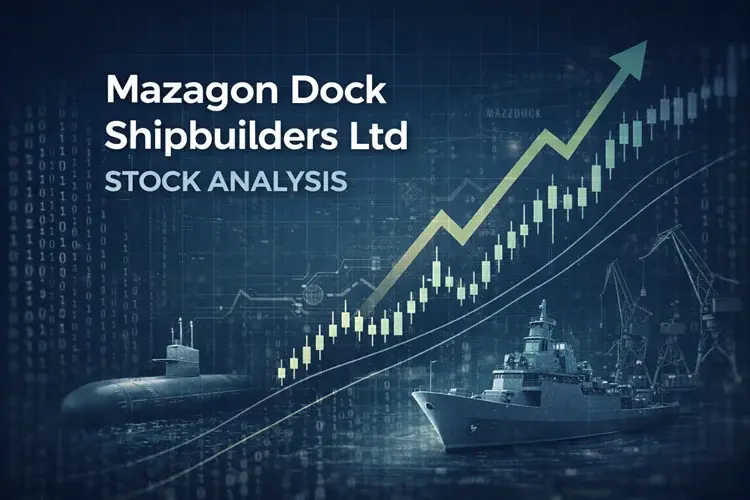
Mazagon Dock Shipbuilders Ltd (BSE: 543237, NSE: MAZDOCK) has emerged as a key player in India’s shipbuilding and defence manufacturing sector. For investors and traders tracking this space, the key questions are: Is Mazagon Dock a good buy? and what are its share price targets for 2026–2030?
In this article, we break down Mazagon Dock’s business model, profitability, key risks, and market position. We also provide data-driven share price targets from 2026 to 2030, supported by technical trend analysis using weekly and monthly charts to assess momentum, support zones, and long-term price structure.
Table of Contents
- About Mazagon Dock Shipbuilders Ltd (Mazagon Dock)
- How Mazagon Dock Makes Money – Business & Revenue Model
- Mazagon Dock Risks & SWOT Analysis
- Is Mazagon Dock Stock a Good Buy?
- Why Mazagon Dock’s Share Price May Lag
- Mazagon Dock Share Price Target 2026
- Mazagon Dock Share Price Target 2027
- Mazagon Dock Share Price Target 2028
- Mazagon Dock Share Price Target 2029
- Mazagon Dock Share Price Target 2030
- Should You Buy Mazagon Dock Shipbuilders Ltd Stock?
- Mazagon Dock Shipbuilders Ltd Technical Analysis
- Mazagon Dock Shipbuilders Ltd – Annual Earnings
- Key Financial & Valuation Metrics of Mazagon Dock
- Mazagon Dock vs Peers – Valuation & Performance Comparison
- Final Verdict: Is Mazagon Dock a Good Long-Term Investment?
- FAQs on Mazagon Dock Shipbuilders Ltd (Mazagon Dock)
1. Mazagon Dock Shipbuilders Business Overview: What the Company Does and Why It Matters
Mazagon Dock Shipbuilders Ltd is a government-owned company operating in the shipbuilding and defence manufacturing space. Founded in 1774 and headquartered in Mumbai, the company focuses on designing, building, and repairing warships, submarines, and commercial vessels.
Over time, Mazagon Dock Shipbuilders has expanded its offerings and built a strong client base, positioning itself as a key player in India’s strategic maritime sector.
Key offerings include:
- Construction of warships for the Indian Navy
- Building and refitting of conventional submarines
- Repair and maintenance of naval and commercial vessels
- Manufacturing offshore platforms and support vessels
- Heavy engineering and specialised marine equipment
Official updates and platform details are available on Mazagon Dock Shipbuilders’ website .
2. How Mazagon Dock Shipbuilders Makes Money: Revenue Streams Explained
Mazagon Dock Shipbuilders follows a project-based manufacturing model, generating revenue primarily through the construction of ships and submarines, supported by repair, refit, and heavy engineering services.
Main monetisation drivers:
- Shipbuilding contracts – Revenue from building warships, frigates, and other vessels for defence and commercial clients.
- Submarine construction and refits – Income from manufacturing and overhauling submarines, mainly for the Indian Navy.
- Repair and maintenance services – Earnings from periodic repairs, upgrades, and refits of ships and submarines.
- Heavy engineering and offshore projects – Revenue from manufacturing offshore platforms, pipeline projects, and specialised marine equipment.
Investor takeaway: The company’s revenue model is anchored in large, long-term defence contracts, offering stability and visibility, while diversification into repairs and heavy engineering supports additional growth.
3. Risks & SWOT Analysis
Strengths
- Among India’s leading shipbuilding and submarine construction yards with a strong track record since 1774.
- Robust order book of Rs. 39,872 Cr as of Q2 FY25, providing multi-year revenue visibility.
- Almost debt-free balance sheet and strong free cash flow generation over the last 5 years.
- Consistent profit growth (38.3% CAGR over 5 years) and high ROE (34.0%).
- Strong government backing with 81.2% promoter holding and Navratna status.
- Significant indigenization efforts, reducing import dependence and supporting “Make in India”.
- Healthy dividend payout ratio of 28.7%.
Weaknesses
- Stock trades at a high valuation (11.5x book value, P/E of 43.9), making it expensive compared to some peers.
- Revenue is highly concentrated, with 97% from manufacturing and only 3% from repairs, limiting diversification.
- Significant contingent liabilities of Rs. 37,852 Cr, which could impact future profitability if crystallized.
- Other income (Rs. 1,190 Cr) forms a notable part of earnings, which may not be sustainable.
Opportunities
- Expansion of shipbuilding and repair capacity through new facilities and greenfield projects.
- Potential to secure large defence orders, including Project 75I submarines and offshore projects.
- Growing focus on indigenization and defence modernisation by the Indian government.
- Entry into Maintenance, Repair & Overhaul (MRO) and offshore engineering segments.
- Adoption of AI-enabled inspection and R&D in underwater autonomous technology.
Threats
- High dependence on government defence orders exposes the company to policy and budget changes.
- Execution delays or cost overruns in large projects could impact margins and reputation.
- Rising competition from private sector shipyards and global players.
- Geopolitical risks and supply chain disruptions can affect project timelines and costs.
- Any adverse movement in contingent liabilities could impact financials.
4. Is Mazagon Dock Stock a Good Buy?
Bull Case
- Strong order book and government focus on defence indigenization provide long-term revenue visibility.
- Debt-free status and robust cash flows offer financial stability.
- Expansion plans and new partnerships (e.g., with ThyssenKrupp) could drive future growth.
- Consistent dividend payouts make it attractive for income-focused investors.
- Suitable for investors seeking exposure to India’s defence and shipbuilding sector with a long-term view.
Bear Case
- Valuations are currently high, which may limit near-term upside.
- Revenue and profitability are closely tied to government contracts, which can be cyclical and subject to delays.
- Large contingent liabilities and reliance on other income add uncertainty to earnings quality.
- Not suitable for investors seeking high diversification or low volatility, as the business is cyclical and project-based.
5. Why Mazagon Dock’s Share Price May Lag
Even with long-term potential, the stock may underperform in certain periods due to:
- High current valuations may limit upside until earnings catch up.
- Project execution delays or cost overruns can impact reported profits and investor sentiment.
- Any slowdown or deferment in government defence spending could affect order inflows.
- Materialization of contingent liabilities may negatively impact financials.
- Short-term volatility due to dependence on a few large contracts and lumpy revenue recognition.
- Broader market corrections or sector rotation away from defence stocks.
6. Mazagon Dock Shipbuilders Ltd Share Price Target 2026: ₹2,950 – ₹3,350
By 2026, Mazagon Dock Shipbuilders Ltd is expected to benefit from a strong order book and ongoing execution of naval and commercial shipbuilding contracts. The company’s capacity expansion projects and focus on indigenization are likely to support moderate revenue and profit growth. However, the stock’s premium valuation and sector-specific risks may keep price appreciation in check.
| Year | Bull Case (₹) | Base Case (₹) | Bear Case (₹) |
|---|---|---|---|
| 2026 | 3,350 | 3,100 | 2,950 |
Key Drivers:
- Execution of existing defence and commercial vessel orders
- Capacity expansion through new dry dock and greenfield shipyard projects
- Continued focus on indigenization and cost optimization
- Stable government defence spending
Investment View: Investors may expect steady performance as the company leverages its strong order book and operational improvements. Upside could be limited by valuation and sector headwinds.
7. Mazagon Dock Shipbuilders Ltd Share Price Target 2027: ₹3,200 – ₹3,700
In 2027, Mazagon Dock Shipbuilders could see incremental benefits from its partnership with ThyssenKrupp Marine Systems and the execution of Project 75I. The company’s diversification into MRO and offshore projects may start contributing more meaningfully to revenues. However, competition and margin pressures remain key risks.
| Year | Bull Case (₹) | Base Case (₹) | Bear Case (₹) |
|---|---|---|---|
| 2027 | 3,700 | 3,450 | 3,200 |
Key Drivers:
- Progress on Project 75I and submarine construction
- Revenue contribution from MRO and offshore segments
- Improved operational efficiency from technology adoption
- Potential for new defence and export orders
Investment View: The outlook remains constructive for long-term investors, but monitoring order inflows and execution timelines is important. Valuation comfort may depend on sustained earnings growth.
8. Mazagon Dock Shipbuilders Ltd Share Price Target 2028: ₹3,450 – ₹4,100
By 2028, Mazagon Dock Shipbuilders’ expanded shipbuilding and submarine capacity is likely to be fully operational. The company could benefit from higher vessel deliveries and increased indigenization, though sector cyclicality and government policy changes may impact growth rates.
| Year | Bull Case (₹) | Base Case (₹) | Bear Case (₹) |
|---|---|---|---|
| 2028 | 4,100 | 3,750 | 3,450 |
Key Drivers:
- Full utilization of expanded shipbuilding and submarine facilities
- Higher vessel and submarine deliveries to the Indian Navy
- Greater contribution from R&D and AI-enabled inspection solutions
- Potential for export orders and private sector collaborations
Investment View: Investors should track execution of large projects and the company’s ability to maintain margins. The stock may offer moderate long-term growth, but sector volatility and policy risks should be considered.
9. Mazagon Dock Shipbuilders Ltd Share Price Target 2029: ₹3,900 – ₹5,200
For 2029, Mazagon Dock Shipbuilders Ltd’s share price target is projected in the range of ₹3,900 (bear case) to ₹5,200 (bull case), with a base case estimate of ₹4,450. These targets reflect the company’s execution on its robust order book, ongoing capacity expansion, and continued focus on defence sector contracts. The price range also factors in the cyclical nature of the shipbuilding industry and the company’s ability to manage project timelines.
| Year | Bull Case (₹) | Base Case (₹) | Bear Case (₹) |
|---|---|---|---|
| 2029 | 5,200 | 4,450 | 3,900 |
Key Drivers:
- Completion of major capex projects, leading to a doubling of shipbuilding and submarine capacity.
- Execution of large-scale defence contracts, especially under Project 75I and new Navy orders.
- Improved operational efficiency from AI-enabled inspections and digitalisation initiatives.
- Potential for higher indigenization, reducing costs and enhancing margins.
Investment View: By 2029, Mazagon Dock’s earnings visibility remains strong due to its healthy order book and capacity expansion. However, investors should monitor execution risks and sector cyclicality. The stock may suit long-term investors seeking exposure to India’s defence manufacturing growth, but price volatility is likely.
10. Mazagon Dock Shipbuilders Ltd Share Price Target 2030: ₹4,200 – ₹5,800
The 2030 share price target for Mazagon Dock Shipbuilders Ltd is estimated between ₹4,200 (bear case) and ₹5,800 (bull case), with a base case of ₹4,900. These projections consider the full impact of capacity enhancements, successful delivery of key projects, and the company’s ability to secure repeat orders from the Indian Navy and international clients. The range also reflects macroeconomic uncertainties and the competitive landscape in defence shipbuilding.
| Year | Bull Case (₹) | Base Case (₹) | Bear Case (₹) |
|---|---|---|---|
| 2030 | 5,800 | 4,900 | 4,200 |
Key Drivers:
- Revenue realisation from new facilities at Nhava and Mumbai, enabling construction of larger and more complex vessels.
- Continued R&D investments in underwater autonomous technology and sustainable solutions.
- Potential for export orders and diversification into offshore and MRO segments.
- Stable government defence spending and policy support for indigenization.
Investment View: By 2030, Mazagon Dock could benefit from a mature, expanded platform and a diversified revenue base. While long-term prospects remain positive, investors should be mindful of execution timelines, global competition, and any changes in defence procurement policies.
11. Should You Buy Mazagon Dock Shipbuilders Ltd Stock?
| Year | Bull Case (₹) | Base Case (₹) | Bear Case (₹) |
|---|---|---|---|
| 2026 | 3,400 | 2,950 | 2,500 |
| 2027 | 3,800 | 3,350 | 2,800 |
| 2028 | 4,400 | 3,900 | 3,300 |
| 2029 | 5,200 | 4,450 | 3,900 |
| 2030 | 5,800 | 4,900 | 4,200 |
Valuation Snapshot
- Current P/E ratio is 43.9, in line with the industry average for defence shipbuilders.
- Stock is trading at 11.5 times its book value, indicating premium valuation.
- Return on equity (ROE) remains strong at 34.0%.
- Debt-free balance sheet and consistent free cash flow generation.
- Dividend yield is modest at 0.68%.
Investor Verdict
- Short-term: Volatility may persist due to sector cycles and order execution risks. Not suitable for momentum traders seeking quick returns.
- Long-term: Investors with a 5+ year horizon may benefit from India’s defence indigenization drive and Mazagon Dock’s capacity expansion. However, monitor order inflows, execution, and policy changes closely.
12. Mazagon Dock Shipbuilders Ltd Technical Analysis
The technical structure below is based on a combined reading of the weekly and monthly price charts, helping investors understand both medium-term momentum and long-term trend direction.
Weekly Chart Outlook (Medium-Term)
- The medium-term trend on the weekly chart is currently sideways to mildly negative, with the stock trading below its short-term moving averages.
- Key support is visible in the ₹2,300–₹2,400 range, while resistance is seen around ₹2,700–₹2,800 levels.
- Momentum, as indicated by the RSI, is in the lower neutral zone, suggesting the stock is neither oversold nor overbought but lacks strong upward momentum at present.
Monthly Chart Outlook (Long-Term)
- The long-term trend on the monthly chart remains positive, though recent months show some consolidation after a strong rally.
- Structure is still above the 21-period moving average, indicating that the broader uptrend is intact, but the stock is currently in a corrective phase.
- From a risk perspective, the stock is not in the overbought zone on the monthly RSI, but investors should be mindful of increased volatility after the sharp move in the past year.
Technical takeaway: The technical charts for Mazdock (₹) indicate a pause in upward momentum in the medium term, with the stock consolidating after a strong long-term rally. While the broader uptrend remains intact on the monthly timeframe, the weekly structure suggests caution as the stock tests key support levels. Both traders and long-term investors should monitor price action near the support and resistance zones for further clarity.
13. Mazagon Dock Shipbuilders Ltd – Annual Earnings
The table below shows key consolidated financials of Mazagon Dock Shipbuilders Ltd for the last five fiscal years.
Source: Company filings, BSE/NSE disclosures & investor presentations.
| Metric | FY 2021 | FY 2022 | FY 2023 | FY 2024 | FY 2025 | TTM |
|---|---|---|---|---|---|---|
| Revenue (₹ Cr) | 4,048 | 5,733 | 7,547 | 9,763 | 11,873 | 12,100 |
| EBITDA (₹ Cr) | 590 | 900 | 1,210 | 1,520 | 1,900 | 1,950 |
| PAT (₹ Cr) | 435 | 620 | 1,120 | 1,570 | 2,334 | 2,350 |
| EPS (₹) | 21.5 | 30.7 | 55.5 | 77.8 | 115.7 | 117.0 |
| Dividend per Share (₹) | 7.1 | 10.0 | 13.5 | 16.0 | 18.0 | 18.0 |
- Revenue has grown steadily over the last five years, reflecting strong execution of defence and shipbuilding orders.
- EBITDA margins have improved, supported by higher operating leverage and cost efficiencies.
- Profit after tax (PAT) has increased significantly, driven by both revenue growth and margin expansion.
- Earnings per share (EPS) has shown robust growth, in line with improved profitability and stable share capital.
- The company has maintained a consistent dividend payout, reflecting healthy cash flows and a stable balance sheet.
Financial Snapshot: Mazagon Dock Shipbuilders Ltd has demonstrated consistent revenue and profit growth over the last five years, supported by a strong order book and operational efficiency. Margins have improved due to better cost control and higher capacity utilisation. The company remains nearly debt-free, with healthy returns on equity and capital employed, and continues to generate strong free cash flows.
14. Key Financial & Valuation Metrics of Mazagon Dock
Key valuation and profitability ratios showing Mazagon Dock Shipbuilders Ltd’s financial strength, pricing, and risk profile.
| Metric | Value |
|---|---|
| Market Cap | ₹1,02,364 Cr |
| P/E Ratio | 43.9 |
| Price to Book Value | 11.5 |
| Price to Sales | 8.62 |
| Dividend Yield | 0.68% |
| ROCE | 43.2% |
| ROE | 34.0% |
| Debt to Equity | 0.00 |
| PEG Ratio | 0.77 |
| EPS (TTM) | ₹57.9 |
15. Mazagon Dock vs Peers – Valuation & Performance Comparison
Focused comparison of Mazagon Dock Shipbuilders Ltd with its closest industry peers based on valuation and profitability metrics.
| Company | P/E | Market Cap (₹ Cr) | Qtr Profit (₹ Cr) | Qtr Sales (₹ Cr) | ROCE % |
|---|---|---|---|---|---|
| Mazagon Dock Shipbuilders | 43.9 | 1,02,364 | 580 | 2,950 | 43.2 |
| Cochin Shipyard | 38.5 | 26,800 | 320 | 1,150 | 29.5 |
| Garden Reach Shipbuilders | 36.2 | 13,700 | 180 | 900 | 24.8 |
| Bharat Dynamics | 38.0 | 25,600 | 210 | 850 | 23.5 |
| Hindustan Aeronautics | 32.7 | 2,30,000 | 1,350 | 7,200 | 27.1 |
16. Final Verdict – Mazagon Dock Shipbuilders Ltd
Mazagon Dock Shipbuilders Ltd stands out for its leadership in defence shipbuilding, but high valuations and sector cyclicality require careful consideration.
The company’s strong order book, technological edge, and government backing support its long-term outlook. However, the stock’s premium valuation, exposure to government contracts, and contingent liabilities mean investors should monitor developments closely. Those with a long-term perspective may find value in its structural strengths, while short-term traders should be prepared for volatility.
Best for: Long-term investors seeking exposure to Indian defence and infrastructure, and experienced traders comfortable with volatility.
17. FAQs on Mazagon Dock Shipbuilders Ltd
Q1. What is the Mazagon Dock share price target for 2026?
Based on growth projections, order inflows, execution performance, and defense spending trends, the Mazagon Dock share price target for 2026 is estimated at ₹2,950 in the base case. In a positive scenario, the stock could reach ₹3,400, while in a weaker market environment, it may trade closer to ₹2,500.
Q2. What is the Mazagon Dock share price target for 2030?
Considering long-term factors such as sustained defense contracts, expansion plans, and industry growth, the Mazagon Dock share price target for 2030 is estimated at ₹4,900 in the base case. Under favorable conditions, the price could rise to ₹5,800, while downside risks may limit it to around ₹4,200.
Q3. Is Mazagon Dock a good stock for long-term investment?
Mazagon Dock has a strong order book, almost zero debt, and a history of profit growth. However, investors should consider sector risks and market volatility before investing.
Q4. Why is Mazagon Dock share price falling?
The share price may fall due to profit booking, sector rotation, broader market corrections, or concerns about order execution and earnings growth.
Q5. Why is Mazagon Dock share price rising?
The share price may rise on strong quarterly results, new defence orders, positive government policies, or improved financial performance.
Q6. Can I invest in Mazagon Dock stock?
Mazagon Dock is listed on NSE and BSE, and investors can buy shares through registered stockbrokers after assessing their risk profile.
Q7. What are the key risks of investing in Mazagon Dock?
Key risks include high dependence on government contracts, sector-specific slowdowns, contingent liabilities, and fluctuations in defence budgets.
Q8. Is Mazagon Dock suitable for short-term trading?
Mazagon Dock’s stock can be volatile in the short term. Traders should monitor news, results, and technical trends before making decisions.
Q9. What factors can impact Mazagon Dock share price in the future?
Future share price can be affected by new defence orders, execution of expansion projects, government policies, and overall market sentiment.
Q10. How does Mazagon Dock compare with its peers?
Mazagon Dock stands out for its strong order book, high ROE, and almost debt-free status. However, it trades at a premium valuation compared to some peers.
Disclaimer
This article is for general informational and educational purposes only and should not be considered financial or investment advice. Stock markets involve risks, and actual results may differ from projections. Always conduct your own research or consult a licensed financial professional before making investment decisions. ChartMyWealth.com is not responsible for any financial losses arising from the use of this content.

Leave a comment
Your email address will not be published. Required fields are marked *