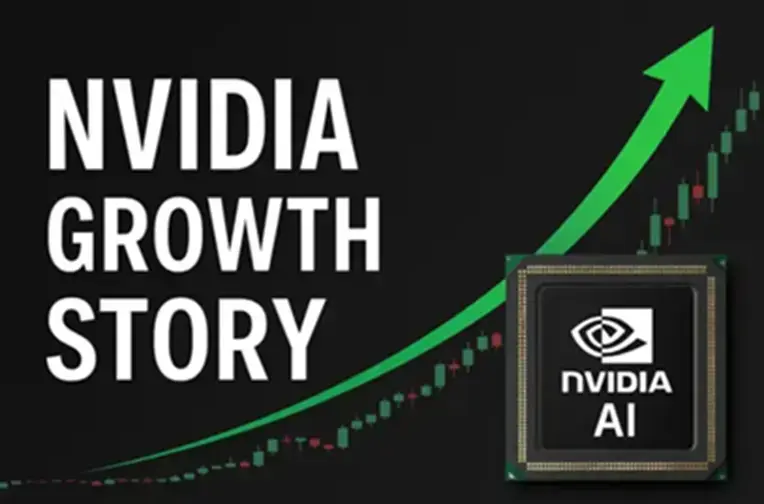
Nvidia’s journey from a 1993 startup to a trillion-dollar AI titan showcases innovation in GPUs, data centers, and artificial intelligence. From the first GeForce GPU to powering modern AI models, Nvidia continues to shape the future of computing and technology.
Table of Contents
- Introduction: Nvidia’s Rise from Silicon Valley
- The Founding Years: 1993–1999
- The GPU Revolution: Birth of GeForce
- Evolution of Nvidia Technologies (2000–2010)
- AI & Data Center Expansion (2011–2020)
- The Trillion-Dollar Milestone (2020–2025)
- Nvidia by the Numbers (Table & Chart)
- Stock Performance & Market Value
- Nvidia’s Strategic Acquisitions
- Nvidia’s Future: AI, Quantum & the Omniverse
- Final Thoughts
- FAQ
1. Introduction: Nvidia’s Rise from Silicon Valley
In the ever-evolving world of technology, few companies have shaped the digital landscape like Nvidia Corporation. Founded in 1993 by Jensen Huang, Chris Malachowsky, and Curtis Priem, Nvidia started with a dream — to make computers visualize the world in real time.
Today, that dream has powered AI models, autonomous vehicles, data centers, and virtual worlds, transforming Nvidia from a small chip designer into a trillion-dollar tech empire.
2. The Founding Years: 1993–1999
In the early 1990s, graphics rendering was slow, costly, and limited to high-end workstations. Nvidia saw an opportunity to change that.
- 1995: Nvidia released its first product, NV1, a 2D/3D multimedia accelerator.
- 1997: The RIVA 128 became a huge success, selling over 1 million units in its first four months.
- 1999: Nvidia introduced the GeForce 256, the world’s first Graphics Processing Unit (GPU) — a term it coined.
That innovation put Nvidia on the map, creating a new era in computer graphics.
3. The GPU Revolution: Birth of GeForce
The GeForce 256 was a breakthrough — it could handle 10 million polygons per second, outperforming all competitors.
By the early 2000s, Nvidia was setting new performance standards:
- 2001 – GeForce 3: Introduced programmable shaders, allowing developers to create lifelike visual effects.
- 2006 – GeForce 8800: Introduced unified shaders and DirectX 10 compatibility, revolutionizing gaming realism.
- 2008 – CUDA platform: Enabled GPUs to perform parallel processing — the foundation for AI and data science.
This single innovation turned the GPU from a gaming tool into a scientific computing powerhouse.
4. Evolution of Nvidia Technologies (2000–2010)
Throughout the 2000s, Nvidia diversified:
- Quadro GPUs: For professionals in CAD, film, and design industries.
- Tesla GPUs: For high-performance computing and research.
- Tegra mobile processors: Powering smartphones, tablets, and even cars.
In 2006, Nvidia was named Company of the Year by Forbes, recognizing its rapid innovation.
5. AI & Data Center Expansion (2011–2020)
As AI emerged, Nvidia made a bold pivot from gaming to artificial intelligence and deep learning.
- 2012: Nvidia’s Kepler architecture improved power efficiency for massive data workloads.
- 2016: Launch of the Pascal architecture and DGX-1 AI supercomputer, accelerating deep learning research.
- 2017: Nvidia entered autonomous vehicles with Drive PX and AI-powered perception systems.
- 2020: Acquisition of Mellanox Technologies ($6.9B) to strengthen data-center interconnectivity.
By 2020, Nvidia GPUs powered 80% of the world’s AI research infrastructure and 10 of the top 10 supercomputers globally.
6. The Trillion-Dollar Milestone (2020–2025)
The 2020s have been Nvidia’s golden age:
- 2023: Nvidia reached a $1 trillion market capitalization, joining Apple, Microsoft, and Amazon.
- 2024: Annual revenue surged past $31.8 billion, up 52% YoY, driven by AI data center demand.
- 2025: Nvidia is projected to exceed $45 billion in revenue, according to Statista.
Key drivers:
- Explosion in AI training and inference workloads.
- Adoption of H100 Tensor Core GPUs across data centers.
- Global partnerships with Microsoft Azure, Amazon AWS, and Google Cloud.
7. Nvidia by the Numbers
Key metrics:
| Metric | 2010 | 2015 | 2020 | 2025 (est.) |
|---|---|---|---|---|
| Revenue ($B) | 3.5 | 5.0 | 16.7 | 45.0 |
| Net Income ($B) | 0.25 | 0.6 | 4.3 | 18.0 |
| Employees | 5,000 | 9,200 | 18,100 | 31,000 |
| Market Cap ($T) | 0.02 | 0.05 | 0.32 | 1.25 |

(Data Source: Nvidia Financial Reports, Statista, MarketWatch)
8. Stock Performance & Market Value
Nvidia’s stock trajectory is one of Wall Street’s most impressive success stories.
- IPO (1999): $12 per share
- 2015: $25 per share
- 2020: $140 per share
- 2025: Over $800 per share, a 6,600% gain since IPO
The company’s price-to-earnings (P/E) ratio remains high, reflecting investor confidence in its AI leadership. Institutional investors like BlackRock, Vanguard, and Fidelity hold major stakes in Nvidia due to its stability and innovation potential.
9. Nvidia’s Strategic Acquisitions
Important acquisitions and purpose:
| Year | Acquisition | Value ($B) | Purpose |
|---|---|---|---|
| 2000 | 3dfx Interactive | 0.38 | Strengthen GPU IP portfolio |
| 2011 | Icera | 0.37 | Mobile chip technology |
| 2020 | Mellanox | 6.9 | Data center interconnects |
| 2022 | Excelero | — | High-performance storage |
| 2023 | Run:ai (Rumored) | — | AI workload orchestration (rumor) |
10. Nvidia’s Future: AI, Quantum & the Omniverse
Looking ahead, Nvidia is focusing on:
- Generative AI: GPUs powering ChatGPT, Gemini, and Anthropic models.
- Omniverse & Digital Twins: Used by BMW, Siemens, and Amazon for industrial simulations.
- Quantum Computing: Partnering with universities to create quantum simulation frameworks.
- Sustainability: Targeting 100% renewable energy operations by 2026.
According to analysts, Nvidia could hit $2 trillion in market value by 2027, driven by cloud AI expansion and hardware dominance.
11. Final Thoughts
Nvidia’s journey from a small Silicon Valley startup to a global AI and GPU powerhouse is nothing short of historic. Its innovations have not only defined gaming but reshaped industries like healthcare, automotive, and space exploration.
From GeForce to AI supercomputers, Nvidia’s story is the perfect example of vision meeting execution — proving that innovation, when guided by purpose, can change the world.
💬 FAQ Section
Q1. When was Nvidia founded and who were the founders?
A1. Nvidia was founded in 1993 by Jensen Huang, Chris Malachowsky, and Curtis Priem in Silicon Valley, California.
Q2. What was Nvidia’s first successful GPU?
A2. The GeForce 256, launched in 1999, was Nvidia’s first major success — it introduced the term “GPU” and revolutionized computer graphics.
Q3. How did Nvidia become a leader in AI technology?
A3. Nvidia transformed its GPUs into AI accelerators through its CUDA platform and AI-focused hardware like the DGX systems, powering deep learning and large-scale data centers.
Q4. When did Nvidia reach a trillion-dollar valuation?
A4. Nvidia hit a $1 trillion market cap in 2023, joining tech giants like Apple and Microsoft.
Q5. What are Nvidia’s future areas of focus?
A5. Nvidia is advancing in generative AI, the Omniverse, quantum computing, and sustainable chip manufacturing powered by renewable energy.
Disclaimer: This article includes publicly available facts and illustrative estimates. Always verify financial figures from primary filings before making investment decisions.

Leave a comment
Your email address will not be published. Required fields are marked *