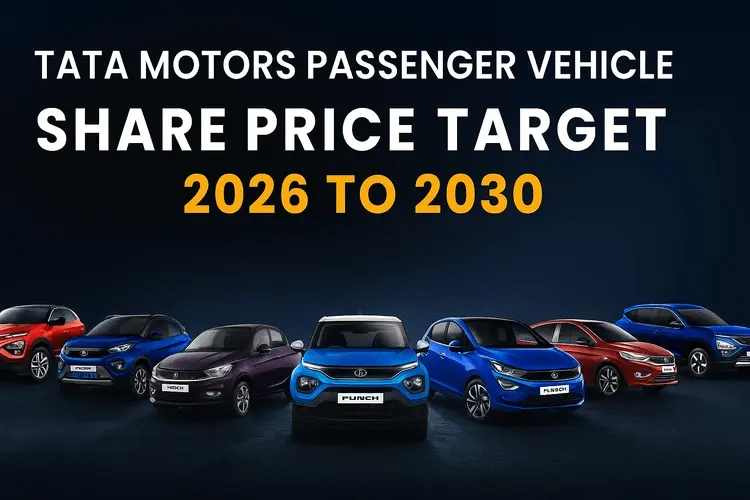
Tata Motors Passenger Vehicles Ltd (TMPV) is one of India’s fastest-growing automobile companies, known for its stylish SUVs, reliable electric cars, and strong safety ratings. Backed by the powerful Tata Group, it has become a major player in India’s EV revolution and passenger car market.
In this article, we discuss everything investors and car enthusiasts need to know — from how Tata Motors PV makes profits, SWOT analysis, share price targets for 2026 to 2030, risks, and whether it’s the right stock to buy now.
Table of Contents
- About Tata Motors Passenger Vehicle
- How Tata Motors Passenger Vehicle Makes Profits
- Risks & SWOT Analysis
- Bull Case vs. Bear Case
- Why Tata Motors Passenger Vehicle Share Price is Falling
- Tata Motors Passenger Vehicle Share Price Target 2026
- Tata Motors Passenger Vehicle Share Price Target 2027
- Tata Motors Passenger Vehicle Share Price Target 2028
- Tata Motors Passenger Vehicle Share Price Target 2029
- Tata Motors Passenger Vehicle Share Price Target 2030
- Should You Buy Tata Motors Passenger Vehicle Stock?
- Competitor Comparison
- User Metrics
- Market Sentiment & Recent Developments
- FAQ on Tata Motors Passenger Vehicle
- Conclusion
1. About Tata Motors Passenger Vehicle
Tata Motors Passenger Vehicles Ltd (TMPV) is a key division of Tata Motors Limited, which was founded in 1945 by J.R.D. Tata under the Tata Group. It focuses on cars, SUVs, and electric vehicles (EVs) and also owns the global luxury brand Jaguar Land Rover (JLR).
✅ Key Highlights
- Parent Company: Tata Motors Ltd (Tata Group)
- Founded: 1945
- CEO & MD: Shailesh Chandra
- Headquarters: Mumbai, Maharashtra
- Key Businesses:
- Tata Motors Passenger Vehicles Ltd – Cars & SUVs
- Tata Passenger Electric Mobility (TPEM) – Electric Vehicles
- Jaguar Land Rover Automotive Plc – Luxury Cars
- Popular Models: Nexon, Punch, Harrier, Safari, Tiago, Altroz, Nexon EV
- Manufacturing Plants: Pune, Sanand, and Ranjangaon
🌟 Strategic Focus
- EV Leadership: Over 75% EV market share in India with models like Nexon EV and Tiago EV.
- Strong SUV Portfolio: Over 75% of Tata PV sales come from SUVs.
- Safety First: Multiple Tata cars have achieved 5-Star Global NCAP ratings.
- Global Reach: Re-entered South Africa market in 2025.
- Sustainability: Committed to full green mobility and carbon-neutral operations by 2030.
TMPV’s separate identity post-demerger helps it focus fully on passenger cars and EVs, making it a strong contender in India’s fast-changing automobile market.
2. How Tata Motors Passenger Vehicle Makes Profits
💰 Revenue Sources
- Domestic sales of cars and SUVs such as Nexon, Punch, and Tiago.
- Electric Vehicles (EVs) with higher selling price and government incentives.
- Luxury segment through JLR.
- After-sales services and spares.
- Exports across Asia, Africa, and South Africa.
📈 Profit Drivers
- Growing SUV and EV market share improves margins.
- Local sourcing and cost optimisation reduce expenses.
- Demerger brings sharper focus and capital allocation.
- Premiumisation trend pushes ASP (average selling price) higher.
3. Risks & SWOT Analysis
Strengths
- Strong and trusted Tata brand name.
- Diverse product portfolio covering mass-market and luxury.
- First-mover advantage in EV technology (Ziptron).
- Focus on safety and design innovation.
- Extensive sales and service network across India.
Weaknesses
- Dependence on JLR for profitability.
- Lower share in entry-level car segment.
- High capex requirement for EV expansion.
- Short-term challenges after demerger.
Opportunities
- Rapid EV adoption in India supported by policies.
- Premiumisation and SUV boom.
- Exports to Africa, ASEAN, and Middle East.
- Synergies with Tata Power, Tata Chemicals, and TCS.
Threats
- Intense competition from Hyundai, Maruti, Kia, and Mahindra.
- Volatile input costs (steel, lithium).
- Global luxury market slowdown impacting JLR.
- Regulatory risks and subsidy changes.
4. Bull Case vs. Bear Case
Bull Case
- Fast growth in car and EV market.
- Strong pipeline of new models like Curvv EV and Harrier EV.
- Higher exports and strong margin expansion.
Bear Case
- Slower EV adoption and raw material inflation.
- Weak JLR demand globally.
- Execution or supply chain risks.
5. Why Tata Motors Passenger Vehicle Share Price is Falling
Tata Motors Passenger Vehicle share price has seen temporary pressure after the recent demerger announcement and global headwinds. Below are some key reasons explaining the fall:
- Post-Demerger Adjustment: Investors are recalibrating valuations between the Commercial Vehicle (CV) and Passenger Vehicle (PV) businesses, leading to short-term volatility.
- Profit Booking: After a strong rally in 2023–2024, some investors booked profits ahead of restructuring news.
- JLR Global Slowdown: Jaguar Land Rover’s sales in Europe and China saw a mild slowdown, impacting consolidated numbers.
- Input Cost Pressure: Lithium and steel price volatility has increased production costs, squeezing margins.
- Chip and Supply Chain Issues: Semiconductor shortages and logistics costs have delayed deliveries.
- Competition: Hyundai, Maruti Suzuki, and Mahindra are aggressively launching new EVs and SUVs, putting pricing pressure on Tata Motors PV.
- Investor Caution: Some retail and FII investors are waiting for clarity post-demerger before taking large positions.
Despite these short-term challenges, analysts believe Tata Motors Passenger Vehicle has strong fundamentals, with EV and SUV growth acting as long-term catalysts.
6. Tata Motors Passenger Vehicle Share Price Target 2026
| Month 2026 | Min Target (₹) | Max Target (₹) |
|---|---|---|
| January | 270 | 320 |
| February | 280 | 330 |
| March | 290 | 350 |
| April | 300 | 360 |
| May | 310 | 370 |
| June | 320 | 380 |
| July | 330 | 400 |
| August | 340 | 420 |
| September | 350 | 430 |
| October | 360 | 440 |
| November | 370 | 460 |
| December | 380 | 480 |
Key Justifications for 2026:
- Successful completion of demerger enhances investor clarity.
- Strong SUV and EV demand driving revenue growth.
- Expansion into South Africa and other export markets boosts sales volume.
- Possible launch of Curvv EV and Harrier EV increasing excitement among investors.
7. Tata Motors Passenger Vehicle Share Price Target 2027
| Year | Min (₹) | Max (₹) |
|---|---|---|
| 2027 | 450 | 550 |
Reasons for 2027 Target:
- EV division profitability starts improving as scale increases.
- Better export margins and cost optimization through localization.
- JLR stabilizes globally with electric luxury models.
- Premiumisation trend in Indian PV market benefits Tata Motors.
8. Tata Motors Passenger Vehicle Share Price Target 2028
| Year | Min (₹) | Max (₹) |
|---|---|---|
| 2028 | 550 | 700 |
Reasons for 2028 Target:
- EV adoption rate crosses 25% in urban markets, favoring Tata’s leadership.
- Harrier EV and Curvv EV gain strong market share.
- Stable input costs and improved battery sourcing reduce volatility.
- Strategic partnerships within Tata Group enhance overall synergies.
9. Tata Motors Passenger Vehicle Share Price Target 2029
| Year | Min (₹) | Max (₹) |
|---|---|---|
| 2029 | 700 | 900 |
Reasons for 2029 Target:
- Strong profitability and steady JLR contribution.
- Exports expand into new African and ASEAN countries.
- Continued focus on digital retail and connected cars.
- EV battery manufacturing partnerships start yielding benefits.
10. Tata Motors Passenger Vehicle Share Price Target 2030
| Year | Min (₹) | Max (₹) |
|---|---|---|
| 2030 | 900 | 1200 |
Reasons for 2030 Target:
- India’s EV revolution fully matures, Tata Motors leads the passenger EV market.
- High-margin models dominate sales, improving EPS and valuation multiples.
- AI-driven manufacturing and smart features boost brand perception.
- Strong investor confidence in Tata Group’s consistent growth and sustainability focus.
11. Should You Buy Tata Motors Passenger Vehicle Stock?
| Year | Min (₹) | Max (₹) |
|---|---|---|
| 2026 | 270 | 480 |
| 2027 | 450 | 550 |
| 2028 | 550 | 700 |
| 2029 | 700 | 900 |
| 2030 | 900 | 1200 |
Overall Justification:
- Strong Long-Term Fundamentals: Leadership in EVs, SUVs, and premium cars.
- High R&D Investment: Focused on technology, battery, and safety innovation.
- Financial Restructuring: Demerger to unlock shareholder value and transparency.
- Strategic Growth: Expanding in global markets with new-age vehicles.
- Risks: Short-term market corrections, input costs, and global economic slowdown.
Investor View: Ideal for long-term investors (3–5 years) looking for sustainable growth in the Indian EV and passenger car space.
12. Competitor Comparison
| Company | Strength | Weakness |
|---|---|---|
| Tata Motors PV | EV leadership, strong SUV lineup | Global luxury exposure risk |
| Maruti Suzuki | Market leader, efficiency | Weak EV presence |
| Hyundai Motor India | Global network, design | Margin pressure |
| Mahindra & Mahindra | Strong SUV heritage | Limited sedan lineup |
13. User Metrics
- Over 61,000 units sold in October 2025 (26.6% YoY growth).
- 77% of sales from SUVs.
- 13.9% contribution to Tata Motors’ consolidated revenue.
14. Market Sentiment & Recent Developments
- Positive investor outlook post-demerger.
- Re-entry into South Africa boosts export potential.
- Upcoming EV models like Curvv EV and Harrier EV.
- Analysts tracking EV adoption and margin trends closely.
15. FAQ on Tata Motors Passenger Vehicle
Q1. Who founded Tata Motors?
Tata Motors was founded by J.R.D. Tata in 1945.
Q2. What is Tata Motors PV?
Tata Motors PV refers to the company’s passenger vehicle division, which focuses on cars, SUVs, and electric vehicles.
Q3. Who is the CEO of Tata Motors PV?
The division is led by Shailesh Chandra.
Q4. What are the top-selling Tata Motors passenger vehicles?
Popular models include the Nexon, Punch, Tiago, Harrier, Safari, and Nexon EV.
Q5. Does Tata Motors lead the EV market?
Yes. Tata Motors holds over 75% market share in the Indian EV segment.
Q6. Why did Tata Motors PV share price fall?
The decline was primarily due to post-demerger valuation adjustments and rising cost pressures.
Q7. What is the Tata Motors PV share price target for 2026?
The estimated target range for 2026 is ₹270 – ₹480.
Q8. What are the key strengths of Tata Motors PV?
Major strengths include brand trust, EV leadership, and a strong safety-focused product lineup.
Q9. Who are the main competitors of Tata Motors PV?
Key competitors include Maruti Suzuki, Hyundai, Mahindra, and Kia.
Q10. Is Tata Motors PV good for long-term investment?
Yes, it is suitable for long-term investors who believe in the growth of India’s EV and SUV market.
16. Conclusion
Tata Motors Passenger Vehicles Ltd stands at the heart of India’s automobile transformation — from traditional cars to electric mobility. With strong branding, 5-star safety, and EV leadership, it offers long-term growth potential for investors. However, short-term volatility may continue due to market realignment and global trends.
📖 Read Also:
Disclaimer
This article is for educational and informational purposes only. It is not financial advice. Please consult a SEBI-registered financial advisor before making any investment decisions. Stock prices and targets are based on analysis and may change with market condition

Leave a comment
Your email address will not be published. Required fields are marked *