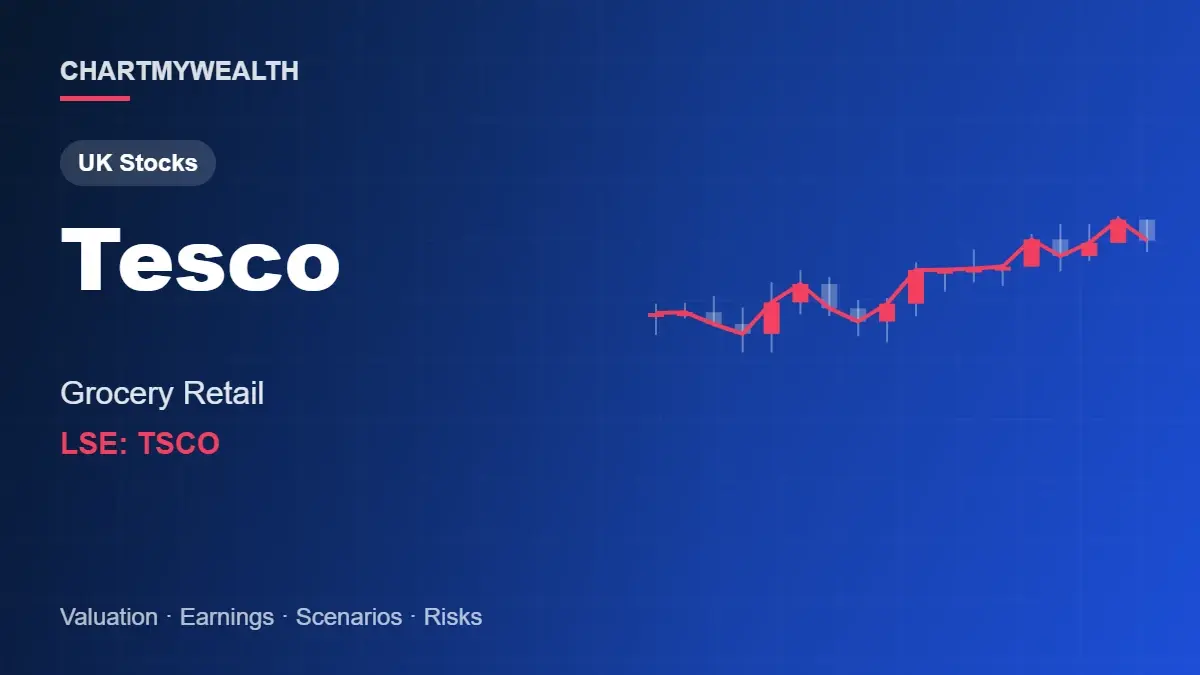
Tesco (LSE: TSCO) price as of 24 Nov 2026 (LSE): £5.5.
Tesco is the UK's largest supermarket, with roughly 28% of the grocery market and more than 4,000 stores across the UK and Ireland. It also owns Booker, the UK's biggest food wholesaler, which supplies convenience stores, restaurants and caterers.
Tesco has quietly become one of the FTSE 100's steadiest performers. It just raised its profit guidance and increased its share buyback to £950 million. This article explains how Tesco makes money and sets out a Tesco share price target for 2027 to 2030 (£5.50 = 550.4p).
Related:Vodafone target · Unilever target · Lloyds target · Our methodology
Table of Contents
- Tesco share price target 2027–2030 at a glance
- How Tesco makes money
- Latest results: what changed
- How we calculate the Tesco share price targets
- Tesco share price in 2026: where it stands
- Tesco share price target 2027: £4.3 – £5.95 (base £5.3)
- Tesco share price target 2028: £4.4 – £6.4 (base £5.6)
- Tesco share price target 2029: £4.45 – £6.95 (base £5.95)
- Tesco share price target 2030: £4.55 – £7.5 (base £6.3)
- Key metrics
- Dividends and shareholder returns
- How it compares with other FTSE 100 stocks
- The key debate on Tesco
- Risks that would break the base case
- What the numbers suggest
- FAQs on the Tesco share price
1. Tesco share price target 2027–2030 at a glance
All three scenarios come from one transparent formula, explained in the method section below. Targets are for the end of each calendar year.
| Year-end | Bear (£) | Base (£) | Bull (£) |
|---|---|---|---|
| 2027 | 4.3 | 5.3 | 5.95 |
| 2028 | 4.4 | 5.6 | 6.4 |
| 2029 | 4.45 | 5.95 | 6.95 |
| 2030 | 4.55 | 6.3 | 7.5 |
The base case implies a price change of roughly 3% a year from today's £5.5 to the end of 2030, before dividends.
2. How Tesco makes money
Tesco's business has three main parts:
- UK & Republic of Ireland retail: Tesco Extra hypermarkets, Superstores, Tesco Metro and Express convenience stores, and online grocery delivery. This generates the vast majority of profit.
- Booker: wholesale food and drink supplies to independent convenience stores (including Premier, Londis and Budgens), pubs, restaurants and caterers.
- Central Europe: stores in the Czech Republic, Slovakia and Hungary.
Clubcard: Tesco's loyalty scheme has around 20 million active members in the UK. Clubcard Prices — discounts only for members — drive loyalty, and the data helps Tesco run a growing retail media (advertising) business, selling targeted promotions to suppliers.
Why the model works: scale gives Tesco better buying terms than smaller rivals, allowing it to match discounters Aldi and Lidl on key prices while still earning a margin. Its "Save to Invest" programme cuts costs to fund lower prices.
Why it matters for the targets: grocery retail is low-margin (Tesco's operating margin is about 4.8%), so small changes in market share, costs or pricing make a big difference to profit. Tesco's earnings growth comes from steady sales growth, cost savings and buybacks, which reduce the share count.
A short history: Jack Cohen founded Tesco in 1919 as a market stall in London's East End. It became the UK's largest grocer in the 1990s. After a 2014 accounting scandal, it sold overseas businesses in Asia and focused on the UK. In 2024 it sold its banking operations to Barclays.
3. Latest results: what changed
| H1 2026/27 (26 weeks to 29 Aug) | Value | Change |
|---|---|---|
| Group sales (ex VAT, ex fuel) | £33.8 billion | +2.0% |
| Adjusted operating profit | £1.783 billion | +6.5% |
| Operating margin | 4.8% | +13 bps |
| UK & ROI adjusted operating profit | £1.557 billion | +6.0% |
| Interim dividend | 5.05p | +5.2% |
| Full-year profit guidance | £3.15–3.30 billion | Raised |
Group sales rose 2.0% to £33.8 billion and adjusted operating profit 6.5% to £1.78 billion, with the operating margin up slightly to 4.8%. The UK and Ireland business earned £1.56 billion, up 6%, while Booker's profit was £163 million.
Tesco raised the bottom of its full-year profit guidance to £3.15–3.30 billion and said it expects to land in the upper half. It increased its 2026/27 buyback to £950 million from £750 million and raised the interim dividend 5.2% to 5.05p. The shares rose about 6% on results day.
4. How we calculate the Tesco share price targets
Target = projected EPS × P/E multiple. We start from the forward EPS of £0.33 implied by the current forward P/E, treat it as FY2027 EPS, and grow it at each scenario's rate for later years. Each year-end target applies a P/E multiple to that year's EPS. Read our full methodology.
- Starting EPS: about £0.33 (33p), implied by a 16.7× forward P/E (Tesco's financial year ends in late February).
- Bear case: EPS grows 2% a year, P/E 13×. Price wars with discounters and higher costs squeeze margins.
- Base case: EPS grows 6% a year, P/E 16×. Steady sales growth, cost savings and buybacks lift EPS; multiple close to today's level.
- Bull case: EPS grows 8% a year, P/E 18×. Market share gains and retail media growth lift margins and the valuation.
| Financial year | Bear EPS (£) | Base EPS (£) | Bull EPS (£) |
|---|---|---|---|
| FY2027 | 0.330 | 0.330 | 0.330 |
| FY2028 | 0.337 | 0.350 | 0.356 |
| FY2029 | 0.343 | 0.371 | 0.385 |
| FY2030 | 0.350 | 0.393 | 0.416 |
Worked example (base, 2027): £0.33 = £0.330 FY2027 EPS → × 16 = £5.3.
Sensitivity — 2030 base-case EPS of £0.393 at different multiples:
| P/E | 13× | 16× | 18× |
|---|---|---|---|
| 2030 price (£) | 5.1 | 6.3 | 7.05 |
The sensitivity table shows why the multiple matters as much as earnings: the same 2030 profit can justify very different prices depending on how much investors are willing to pay for it.
5. Tesco share price in 2026: where it stands
With only weeks left in 2026, a year-end "target" is not meaningful. The stock was at £5.5 on 24 Nov 2026, within a 52-week range of 411.70p – 622.50p. The shares are about 12% below their 52-week high.
6. Tesco share price target 2027: £4.3 – £5.95 (base £5.3)
Based on FY2027 EPS of £0.330 / £0.330 / £0.330 (bear / base / bull). What to watch: UK grocery market share versus Aldi, Lidl and Sainsbury's.
7. Tesco share price target 2028: £4.4 – £6.4 (base £5.6)
Based on FY2028 EPS of £0.337 / £0.350 / £0.356 (bear / base / bull). What to watch: Operating margin holding near 4.8%.
8. Tesco share price target 2029: £4.45 – £6.95 (base £5.95)
Based on FY2029 EPS of £0.343 / £0.371 / £0.385 (bear / base / bull). What to watch: Food price inflation and wage costs.
9. Tesco share price target 2030: £4.55 – £7.5 (base £6.3)
Based on FY2030 EPS of £0.350 / £0.393 / £0.416 (bear / base / bull). What to watch: The size of buybacks.
10. Key metrics
Tesco generates strong free cash flow — guided at £1.5–2.0 billion this year — which funds dividends and buybacks.
| Metric | Value | Why it matters |
|---|---|---|
| Forward EPS (est.) | ~£0.33 | Starting point |
| Trailing P/E | 18.6× | Fair for a market leader |
| Forward P/E | 16.7× | Starting multiple |
| Operating margin | 4.8% | Thin, typical for grocers |
| Dividend yield | 2.7% | Plus buybacks |
11. Dividends and shareholder returns
Tesco pays an interim and a final dividend each year, worth about 15p per share over the last 12 months — a yield of roughly 2.7%. On top of that, it is buying back £950 million of shares this year, equivalent to almost 3% of its market value.
Dividends plus buybacks mean Tesco returns most of its free cash flow to shareholders.
12. How it compares with other FTSE 100 stocks
| Company | Price | Trailing P/E | Forward P/E | Dividend yield | 52-week range |
|---|---|---|---|---|---|
| Tesco (TSCO) | 550.40p | 18.6× | 16.7× | 2.7% | 411.70p – 622.50p |
| Vodafone (VOD) | 102.90p | n/a (loss) | 14.1× | 3.9% | 89.44p – 132.07p |
Prices as of 24 Nov 2026 (LSE). See also our Unilever, Barclays and BP targets.
13. The key debate on Tesco
The bull argument: Tesco is the UK's dominant grocer, with scale, a powerful loyalty scheme and a growing advertising business. Profit is growing faster than sales, cash flow is strong and buybacks steadily reduce the share count.
The bear argument: Grocery is fiercely competitive, with discounters Aldi and Lidl still gaining share and Asda cutting prices. Rising wage costs and taxes squeeze margins, and growth is slow — sales rose just 2% in the first half.
How to tell which side is winning: Watch market share and operating margin. Stable share with margins near 4.8% supports the base case; a price war that cuts margins would point to the bear case.
14. Risks that would break the base case
- A supermarket price war cutting margins.
- Rising wage, energy and employer tax costs.
- Discounters gaining market share.
- Weak UK consumer spending.
- Regulatory scrutiny of food prices.
15. What the numbers suggest
Our base case of £6.3 by 2030 assumes 6% annual EPS growth and a stable 16× multiple. With a 2.7% dividend yield and large buybacks, total returns could be steady. The bear case (£4.55) shows the risk of a price war.
Who might consider Tesco: investors looking for a defensive UK stock with steady cash returns and modest growth.
This is a framework, not a recommendation. Your own decision should depend on your time horizon, risk tolerance and existing holdings.
16. FAQs on the Tesco share price
What is the Tesco share price target for 2027?
Our base case is £5.3, assuming 6% annual EPS growth and a 16× P/E. The range is £4.3 (bear) to £5.95 (bull).
What is the Tesco share price target for 2030?
Base case £6.3; range £4.55 to £7.5. It assumes FY2030 EPS of about £0.393.
What is Tesco's market share?
Around 28% of the UK grocery market.
Does Tesco pay a dividend?
Yes, twice a year — about 15p per share over the last 12 months — plus a £950 million buyback this year.
Does Tesco still own Tesco Bank?
No. It sold its banking operations to Barclays in 2024 but keeps insurance and a partnership with Barclays.
What is Booker?
The UK's largest food wholesaler, owned by Tesco, supplying convenience stores and caterers.
What is Clubcard?
Tesco's loyalty scheme, which offers members exclusive Clubcard Prices.
About this analysis: Prepared by the ChartMyWealth Editorial Team using the scenario method described in our methodology. Prices and results were reviewed on 24 Nov 2026, and targets are reviewed after each results announcement.
Disclaimer: This article is for educational purposes only and is not investment advice or a recommendation to buy or sell any security. Price targets are scenario estimates based on the stated assumptions and may not materialise. Please consult an FCA-authorised financial adviser before making investment decisions.

Leave a comment
Your email address will not be published. Required fields are marked *