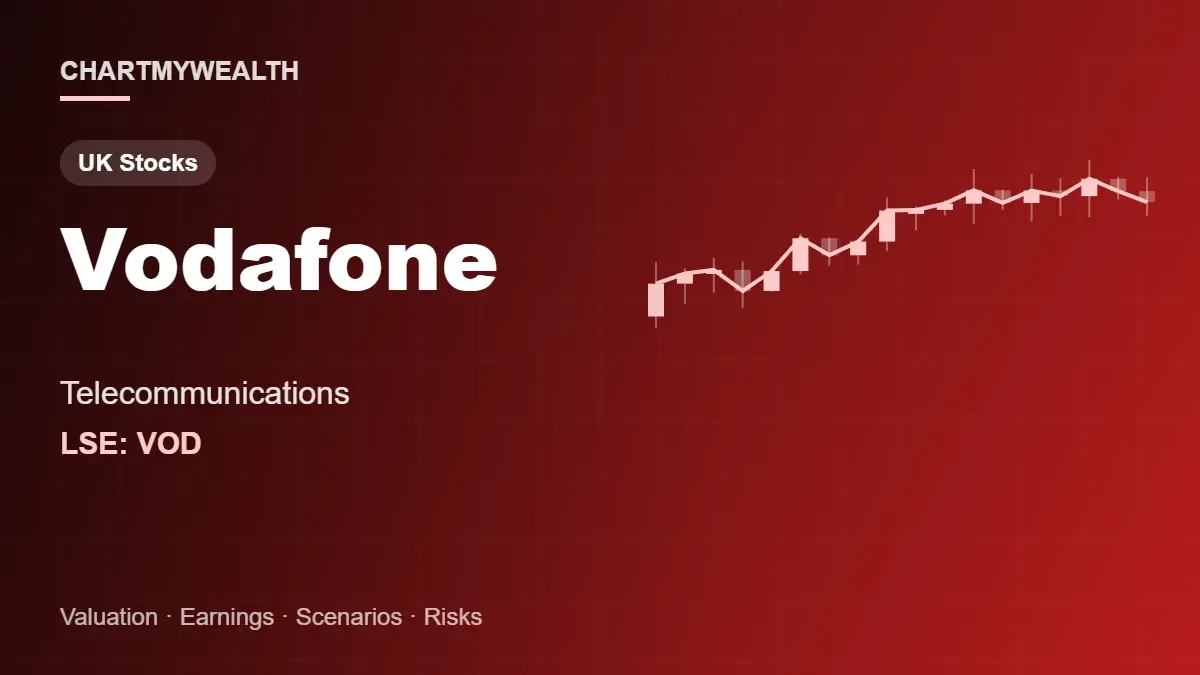
Vodafone (LSE: VOD) price as of 24 Nov 2026 (LSE): £1.03.
Vodafone is one of the world's largest telecom companies, with mobile and broadband customers across Europe and Africa. Once the UK's most valuable company, its share price has fallen sharply over the past decade, and it now trades around £1 (about 103p).
Under CEO Margherita Della Valle, Vodafone has sold weaker businesses, merged its UK operations with Three, and cut its dividend to invest in its networks. Its latest half-year results showed faster growth and raised guidance, but also a large write-down in Germany. This article sets out a Vodafone share price target for 2027 to 2030.
Related:Tesco target · Unilever target · Lloyds target · Our methodology
Table of Contents
- Vodafone share price target 2027–2030 at a glance
- How Vodafone makes money
- Latest results: what changed
- How we calculate the Vodafone share price targets
- Vodafone share price in 2026: where it stands
- Vodafone share price target 2027: £0.73 – £1.17 (base £0.99)
- Vodafone share price target 2028: £0.73 – £1.29 (base £1.06)
- Vodafone share price target 2029: £0.73 – £1.42 (base £1.13)
- Vodafone share price target 2030: £0.73 – £1.56 (base £1.21)
- Key metrics
- Dividends and shareholder returns
- How it compares with other FTSE 100 stocks
- The key debate on Vodafone
- Risks that would break the base case
- What the numbers suggest
- FAQs on the Vodafone share price
1. Vodafone share price target 2027–2030 at a glance
All three scenarios come from one transparent formula, explained in the method section below. Targets are for the end of each calendar year.
| Year-end | Bear (£) | Base (£) | Bull (£) |
|---|---|---|---|
| 2027 | 0.73 | 0.99 | 1.17 |
| 2028 | 0.73 | 1.06 | 1.29 |
| 2029 | 0.73 | 1.13 | 1.42 |
| 2030 | 0.73 | 1.21 | 1.56 |
The base case implies a price change of roughly 4% a year from today's £1.03 to the end of 2030, before dividends.
2. How Vodafone makes money
After several years of restructuring, Vodafone's main businesses are:
- Germany: Vodafone's largest market, with mobile, cable broadband and TV customers. It has struggled since a 2024 law ended bulk TV contracts in apartment buildings and remains the key problem area.
- UK (VodafoneThree): the merged business with Three UK, completed in 2025, which created the UK's largest mobile operator and plans heavy investment in 5G.
- Other Europe: operations in Turkey, Portugal, Ireland, Greece, Romania, the Czech Republic and others.
- Africa (Vodacom): mobile services and M-Pesa mobile money in South Africa, Egypt, Tanzania, Mozambique and other markets — one of Vodafone's fastest-growing regions.
- Vodafone Business: connectivity, cloud and IoT services for companies.
Vodafone sold its Spanish and Italian businesses in 2024 to focus on markets where it can be a strong number one or two.
Why it matters for the targets: Vodafone's earnings recovery depends on stabilising Germany, delivering cost savings from the UK merger and continued growth in Africa and Turkey. Its high debt and heavy network spending limit how much cash is left for shareholders.
A short history: Vodafone made Britain's first mobile phone call in 1985. Its £112 billion takeover of Germany's Mannesmann in 2000 was then the largest in history. It later sold its stake in Verizon Wireless in 2014 for $130 billion, returning much of the proceeds to shareholders.
3. Latest results: what changed
| H1 FY27 (six months to 30 Sep) | Value | Note |
|---|---|---|
| Organic service revenue growth | +5.8% | Group |
| Germany organic service revenue | +0.4% | Barely growing |
| Germany organic EBITDAaL | −3.2% | Still declining |
| Germany goodwill write-down | €4.85 billion | Non-cash |
| FY27 adjusted EBITDAaL guidance | €13.2–13.4 billion | Raised |
| Interim dividend | 2.306 euro cents | — |
Group organic service revenue grew 5.8%, and Vodafone raised its full-year guidance: adjusted EBITDAaL is now expected at €13.2–13.4 billion and adjusted free cash flow at €2.8–3.0 billion.
Germany remains weak. Service revenue grew only 0.4% organically and EBITDAaL fell 3.2%. Vodafone wrote down the value of its German business by €4.85 billion, leading to a statutory loss of €3.6 billion for the half — a non-cash charge that does not affect the dividend. The interim dividend is 2.306 euro cents per share.
4. How we calculate the Vodafone share price targets
Target = projected EPS × P/E multiple. We start from the forward EPS of £0.0731 implied by the current forward P/E, treat it as FY2027 EPS, and grow it at each scenario's rate for later years. Each year-end target applies a P/E multiple to that year's EPS. Read our full methodology.
- Starting EPS: about £0.073 (7.3p), implied by a 14.1× forward P/E. Reported EPS is negative because of a goodwill write-down in Germany.
- Bear case: EPS grows 0% a year, P/E 10×. Germany keeps declining and competition limits growth; the stock stays cheap.
- Base case: EPS grows 7% a year, P/E 13.5×. Germany stabilises, UK merger savings arrive and Africa grows; the multiple eases slightly.
- Bull case: EPS grows 10% a year, P/E 16×. Turnaround accelerates, debt falls and the market re-rates Vodafone.
| Financial year | Bear EPS (£) | Base EPS (£) | Bull EPS (£) |
|---|---|---|---|
| FY2027 | 0.073 | 0.073 | 0.073 |
| FY2028 | 0.073 | 0.078 | 0.080 |
| FY2029 | 0.073 | 0.084 | 0.088 |
| FY2030 | 0.073 | 0.090 | 0.097 |
Worked example (base, 2027): £0.0731 = £0.073 FY2027 EPS → × 13.5 = £0.99.
Sensitivity — 2030 base-case EPS of £0.090 at different multiples:
| P/E | 10× | 13.5× | 16× |
|---|---|---|---|
| 2030 price (£) | 0.9 | 1.21 | 1.43 |
The sensitivity table shows why the multiple matters as much as earnings: the same 2030 profit can justify very different prices depending on how much investors are willing to pay for it.
5. Vodafone share price in 2026: where it stands
With only weeks left in 2026, a year-end "target" is not meaningful. The stock was at £1.03 on 24 Nov 2026, within a 52-week range of 89.44p – 132.07p. The shares are about 22% below their 52-week high.
6. Vodafone share price target 2027: £0.73 – £1.17 (base £0.99)
Based on FY2027 EPS of £0.073 / £0.073 / £0.073 (bear / base / bull). What to watch: Return to growth in Germany.
7. Vodafone share price target 2028: £0.73 – £1.29 (base £1.06)
Based on FY2028 EPS of £0.073 / £0.078 / £0.080 (bear / base / bull). What to watch: Cost savings from the VodafoneThree merger.
8. Vodafone share price target 2029: £0.73 – £1.42 (base £1.13)
Based on FY2029 EPS of £0.073 / £0.084 / £0.088 (bear / base / bull). What to watch: Africa and Turkey growth (including currency effects).
9. Vodafone share price target 2030: £0.73 – £1.56 (base £1.21)
Based on FY2030 EPS of £0.073 / £0.090 / £0.097 (bear / base / bull). What to watch: Debt reduction and free cash flow.
10. Key metrics
Vodafone's trailing P/E is not meaningful because of the German write-down; the forward P/E reflects expected underlying earnings.
| Metric | Value | Why it matters |
|---|---|---|
| Forward EPS (est.) | ~£0.073 | Starting point |
| Trailing EPS | Negative | Write-down |
| Forward P/E | 14.1× | Starting multiple |
| FY27 adjusted FCF guidance | €2.8–3.0 billion | Funds dividend |
| Dividend yield | 3.9% | After the 2024 cut |
11. Dividends and shareholder returns
Vodafone halved its dividend in 2024 to fund network investment and reduce debt, but it has since adopted a progressive policy, aiming to grow the payout over time. The current yield is about 3.9%. It has also bought back shares using proceeds from asset sales.
Dividends are declared in euro cents, so the amount UK investors receive in pence depends on exchange rates.
12. How it compares with other FTSE 100 stocks
| Company | Price | Trailing P/E | Forward P/E | Dividend yield | 52-week range |
|---|---|---|---|---|---|
| Tesco (TSCO) | 550.40p | 18.6× | 16.7× | 2.7% | 411.70p – 622.50p |
| Vodafone (VOD) | 102.90p | n/a (loss) | 14.1× | 3.9% | 89.44p – 132.07p |
Prices as of 24 Nov 2026 (LSE). See also our Unilever, Barclays and BP targets.
13. The key debate on Vodafone
The bull argument: Vodafone is simpler after selling Spain and Italy, growth has returned at group level, and guidance was just raised. The UK merger brings cost savings, Africa offers strong growth, and the stock trades at a low valuation.
The bear argument: Germany — Vodafone's biggest market — is still shrinking, and the latest write-down shows how much value has been lost. Debt is high, network spending is heavy and telecom competition limits price increases.
How to tell which side is winning: Watch Germany's service revenue and EBITDAaL. A return to growth supports the base and bull cases; further declines would point to the bear case.
14. Risks that would break the base case
- Continued decline in Germany.
- High debt and rising interest costs.
- Price competition in European telecoms.
- Currency volatility in Turkey and Africa.
- Integration risk in the UK merger.
15. What the numbers suggest
Our base case of £1.21 by 2030 assumes 7% annual EPS growth as Germany stabilises and the UK merger delivers savings. With a near-4% dividend yield, total returns could be reasonable. The bear case (£0.73) assumes no recovery in Germany.
Who might consider Vodafone: value and income investors who believe the turnaround will work and can accept slow, uneven progress.
This is a framework, not a recommendation. Your own decision should depend on your time horizon, risk tolerance and existing holdings.
16. FAQs on the Vodafone share price
What is the Vodafone share price target for 2027?
Our base case is £0.99, assuming 7% annual EPS growth and a 13.5× P/E. The range is £0.73 (bear) to £1.17 (bull).
What is the Vodafone share price target for 2030?
Base case £1.21; range £0.73 to £1.56. It assumes FY2030 EPS of about £0.090.
Why did Vodafone report a loss?
Because of a €4.85 billion non-cash write-down of its German business.
Does Vodafone pay a dividend?
Yes, twice a year. The interim dividend is 2.306 euro cents per share.
Did Vodafone merge with Three?
Yes, the VodafoneThree merger in the UK completed in 2025.
Who is Vodafone's CEO?
Margherita Della Valle, appointed in 2023.
What is Vodacom?
Vodafone's African subsidiary, which runs mobile networks and M-Pesa in several countries.
Why is Vodafone's share price so low compared with the past?
Years of weak growth in Europe, high debt, write-downs in Germany and a dividend cut have reduced the value investors place on the business.
About this analysis: Prepared by the ChartMyWealth Editorial Team using the scenario method described in our methodology. Prices and results were reviewed on 24 Nov 2026, and targets are reviewed after each results announcement.
Disclaimer: This article is for educational purposes only and is not investment advice or a recommendation to buy or sell any security. Price targets are scenario estimates based on the stated assumptions and may not materialise. Please consult an FCA-authorised financial adviser before making investment decisions.

Leave a comment
Your email address will not be published. Required fields are marked *