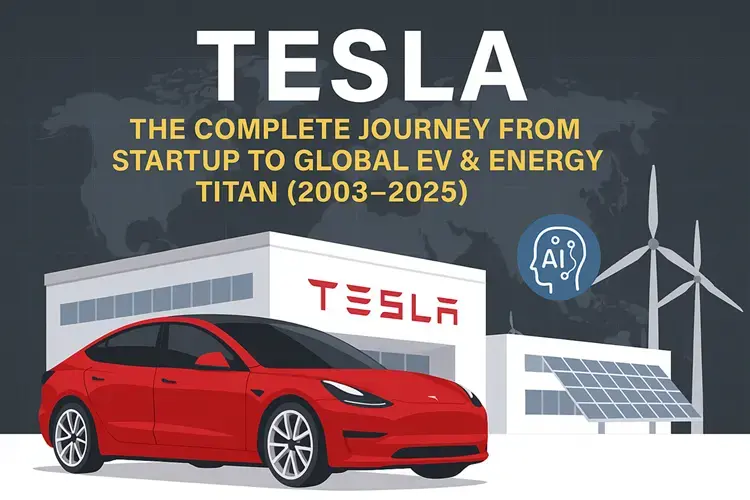
Tesla’s extraordinary rise from a 2003 startup to a global EV and clean-energy powerhouse showcases how innovation, AI, and sustainability can reshape industries. This in-depth feature explores Tesla’s history, growth, Gigafactories, AI advancements, financial journey, and what lies ahead for the company’s future in electric mobility and renewable energy.
Table of Contents
- Introduction: Tesla’s Electrifying Vision
- The Founding Story (2003–2008)
- Roadster Revolution and Early Struggles
- Model S & the Luxury EV Breakthrough
- Gigafactories and Global Expansion
- Tesla Energy: Beyond Cars
- Autonomous Driving, AI & Robotics
- Financial Performance and Stock Growth
- Tesla by the Numbers (Table & Chart)
- Major Milestones in Tesla’s Journey
- Tesla’s Future: AI, Energy, and the Next Decade
- Final Thoughts
1. Introduction: Tesla’s Electrifying Vision
When Tesla Motors (now Tesla, Inc.) was founded in 2003, the world viewed electric vehicles (EVs) as impractical. Two decades later, Tesla has redefined the automotive and energy industries, proving that sustainability and profitability can coexist.
Led by visionary CEO Elon Musk, Tesla has become a symbol of innovation, driving the world toward an all-electric, zero-emission future. As of 2025, Tesla stands as the largest EV manufacturer globally, with a market capitalization in the hundreds of billions. For Tesla’s latest investor updates, see Tesla Investor Relations.
2. The Founding Story (2003–2008)
Tesla was founded by Martin Eberhard and Marc Tarpenning in 2003, with a mission to prove that electric cars could be faster, cleaner, and more desirable than gasoline vehicles.
Elon Musk joined in 2004 as an early investor, leading Tesla’s Series A funding round of $6.5 million and becoming Chairman of the Board.
Early challenges were immense — limited battery technology, low investor confidence, and high production costs. But Tesla pushed forward with a radical idea: a high-performance electric sports car.
3. Roadster Revolution and Early Struggles
In 2008, Tesla launched the Roadster, its first production car. Powered by lithium-ion batteries, it could accelerate from 0–60 mph in 3.9 seconds — unheard of for EVs at the time.
However, the 2008 financial crisis and high production costs nearly bankrupted Tesla. Elon Musk personally invested millions and secured emergency funding to keep Tesla afloat.
That same year, Musk officially became CEO and Product Architect, setting the stage for Tesla’s meteoric rise.
4. Model S & the Luxury EV Breakthrough
Tesla’s Model S (launched in 2012) changed everything.
- Won Motor Trend’s Car of the Year (2013).
- Offered 265-mile range, the best of any EV at the time.
- Introduced over-the-air software updates, a first in automotive history.
Following Model S came a series of groundbreaking launches:
| Year | Model | Highlights |
|---|---|---|
| 2015 | Model X | First luxury electric SUV with Falcon Wing doors |
| 2017 | Model 3 | Affordable EV for the mass market |
| 2020 | Model Y | Compact SUV – Tesla’s best-selling car |
| 2023 | Cybertruck | Stainless-steel exoskeleton and futuristic design |
The Model 3, priced around $35,000 at launch, brought EVs to mainstream consumers, making Tesla the best-selling electric car brand globally.
5. Gigafactories and Global Expansion
To meet rising demand, Tesla built Gigafactories — massive production facilities designed for scale and efficiency.
| Location | Year | Specialty |
|---|---|---|
| Nevada, USA | 2016 | Battery cells & storage systems |
| Shanghai, China | 2019 | Model 3 & Y production for Asia |
| Berlin, Germany | 2022 | European EV manufacturing |
| Texas, USA | 2022 | Cybertruck, Semi & Model Y |
| Mexico | 2025 (under construction) | Next-gen compact EVs |
These factories enabled Tesla to reduce costs, increase production speed, and control its supply chain — a key factor behind its improved margins and profitability.
6. Tesla Energy: Beyond Cars
Tesla’s mission extends far beyond automobiles.
- 2015: Launch of Powerwall and Powerpack, enabling home and commercial energy storage.
- 2016: Acquisition of SolarCity for $2.6B, forming Tesla Energy.
- 2021: Introduced Megapack, a grid-scale battery used by utilities.
By 2025, Tesla Energy contributes nearly 10–15% of Tesla’s total revenue, with solar and storage deployments exceeding 10 GWh annually (company deployments tracking via Tesla IR). :contentReference[oaicite:2]{index=2}
7. Autonomous Driving, AI & Robotics
Tesla has positioned itself as both an automaker and an AI software company.
Autopilot & Full Self-Driving (FSD)
- Uses neural networks trained on billions of miles of driving data.
- Over 2 million Tesla vehicles have contributed real-world data (fleet learning powers model training).
- In 2025, Tesla’s FSD (v12.x) claims Level 4 autonomy in select U.S. cities — deployments are regionally limited and closely monitored for safety and regulation.
Dojo Supercomputer
Tesla announced production use of the Dojo supercomputer in mid-2023 for training driving neural nets, promising exascale-class performance. Industry coverage tracked Dojo’s production startup in July 2023. :contentReference[oaicite:3]{index=3}
However, in 2025 Reuters reported organization changes and reassignments related to the Dojo team as Tesla adjusted its AI strategy. This indicates Tesla’s AI roadmap is dynamic and integrates external AI partnerships alongside in-house projects. :contentReference[oaicite:4]{index=4}
Optimus Robot
Unveiled in 2022, Tesla’s humanoid robot Optimus is designed for repetitive tasks in factories and households. 2025 prototypes were reported to be used in limited factory tasks in early deployments.
8. Financial Performance and Stock Growth
Tesla’s growth trajectory remains one of the most astonishing in corporate history.
- 2010: Tesla IPO at $17/share.
- 2020: 5-for-1 stock split.
- 2025: Stock trading in the range consistent with large-cap tech/auto valuations (market caps fluctuate rapidly — check current market data). For the company’s official results, see Tesla Investor Relations. :contentReference[oaicite:5]{index=5}
| Metric | Value |
|---|---|
| Market Cap (2025, approximate) | ~$850B (dynamic — verify on market pages) |
| 2024 Revenue | $96.7B (company reported; see 2024 financial results). :contentReference[oaicite:6]{index=6} |
| Net Income (2024) | ~$14.8B |
| Gross Margin (automotive) | ~25.6% |
Tip: For live stock prices and market cap, use your preferred market-data provider (e.g., Yahoo Finance, Google Finance, MacroTrends).
9. Tesla by the Numbers (Table & Chart)
| Metric | 2015 | 2020 | 2023 | 2025 (est.) |
|---|---|---|---|---|
| Vehicle Deliveries | 50,000 | 500,000 | 1.8M | 2.4M |
| Revenue ($B) | 4.0 | 31.5 | 95.9 | 110 |
| Net Income ($B) | -0.9 | 0.7 | 12.6 | 15 |
| Employees | 14,000 | 70,800 | 140,000 | 155,000 |
| Market Cap ($B) | 25 | 650 | 880 | 850+ |
Vehicle Deliveries (Millions)Data sources include Tesla annual reports and investor releases; projections are company estimates and analyst consensus. For Tesla's official production & delivery releases (quarterly updates), see Tesla IR.
10. Major Milestones in Tesla’s Journey
| Year | Milestone |
|---|---|
| 2003 | Tesla Motors founded |
| 2008 | First Roadster launched |
| 2010 | Tesla IPO on NASDAQ |
| 2012 | Model S released |
| 2016 | SolarCity acquisition |
| 2020 | Became world’s most valuable automaker (briefly) |
| 2023 | Cybertruck deliveries begin (initial batches) |
| 2024 | Dojo AI chip enters production stage (company announced progress) |
| 2025 | Tesla approaches 2.5M EV deliveries (company/analyst estimates) |
11. Tesla’s Future: AI, Energy, and the Next Decade
Tesla’s roadmap for the next decade centers on three pillars:
1. Next-Gen Affordable EVs
• $25,000 compact EV under development (codenamed “Model 2”). • Expected to launch by 2026, aimed at emerging markets.
2. AI & Robotics
• Expansion of Dojo AI cluster to train autonomous driving globally. • Large-scale production of Optimus robots for logistics and manufacturing.
3. Sustainable Energy Ecosystem
• Integration of solar, storage, and EVs into a single energy ecosystem. • Goal: 100% renewable energy supply across all operations by 2030.
According to some analysts and market watchers, Tesla could reach $1 trillion in market cap again by 2027 with successful execution on affordable vehicles and AI/robotics, but these projections are speculative and depend on competition, supply chain, and regulation.
12. Final Thoughts
Tesla’s story is a testament to vision, perseverance, and relentless innovation. From an ambitious startup to a world leader in EVs, energy, and AI, Tesla has redefined what’s possible in sustainable technology.
As the company continues to expand its reach into autonomy, AI computing, and renewable energy, Tesla is not just building cars — it’s building the foundation for a cleaner, smarter future.
FAQ
Q1. When was Tesla founded and who were the founders?
A1. Tesla was founded in 2003 by Martin Eberhard and Marc Tarpenning. Elon Musk joined in 2004 as an early investor and Chairman.
Q2. What was Tesla’s first production car?
A2. The Tesla Roadster, launched in 2008, was the company’s first production EV, capable of 0–60 mph in 3.9 seconds.
Q3. When did Tesla go public?
A3. Tesla held its IPO on NASDAQ in 2010 at $17 per share.
Q4. What are Tesla’s key business divisions?
A4. Tesla operates in three main areas: EV manufacturing, energy solutions (Powerwall, Megapack, Solar), and AI/robotics (Autopilot, Dojo, Optimus).
Q5. What is Tesla’s future roadmap?
A5. Tesla aims to launch affordable EVs (Model 2), expand AI/robotics capabilities, and integrate a sustainable energy ecosystem with 100% renewable operations by 2030.
Sources & Further Reading
- Tesla — 2024 Financial Results (Investor Relations).
- Tesla — Q2 2025 Production, Deliveries & Deployments (Investor Relations).
- Reuters — Tesla reorganizes Dojo team (Aug 2025).
- The Verge — Tesla starts production of Dojo (Jul 2023).
- AP News — Tesla sales fell in 2024 (Jan 2025).
For the most recent numbers (market cap, deliveries, quarterly results), check Tesla's Investor Relations page or your preferred market data provider; some numbers above are company-reported or analyst estimates and are subject to revision.
Disclaimer: This article is for educational and informational purposes; it is not investment advice. Always perform your own due diligence before investing.

Leave a comment
Your email address will not be published. Required fields are marked *