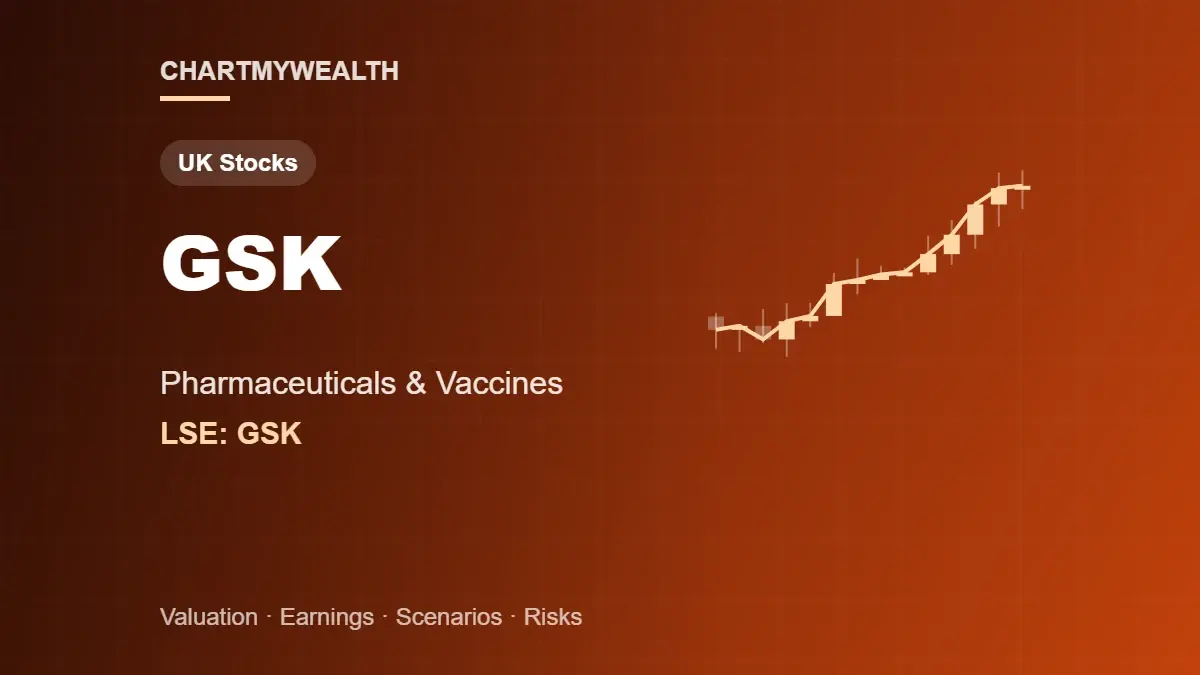
GSK (LSE: GSK) price as of 27 Nov 2026 (LSE): £19.36.
GSK (formerly GlaxoSmithKline) is one of the UK's largest pharmaceutical companies, making medicines for HIV, cancer, respiratory and immune diseases, plus vaccines such as Shingrix for shingles and Arexvy for RSV. After spinning off its consumer health business (Haleon) in 2022, GSK is now a focused biopharma company.
New CEO Luke Miels, who took over at the start of 2026, is accelerating growth in specialty medicines while vaccines face a tougher patch. The stock trades at a low valuation compared with other big drugmakers. This article explains how GSK makes money and sets out a GSK share price target for 2027 to 2030 (£19.36 = 1,935.5p).
Related:L&G target · AstraZeneca target · Lloyds target · Our methodology
Key takeaways
- GSK is a UK-listed pharmaceutical company focused on specialty medicines and vaccines.
- Q3 2026 sales grew 5% with specialty medicines up 15%, while vaccines declined.
- The stock trades at only about 10.5× forward earnings — cheap for a big pharma company.
- Our base case GSK share price target for 2030 is £26, plus a dividend yield of about 3.5%.
Table of Contents
- GSK share price target 2027–2030 at a glance
- How GSK makes money
- Latest results: what changed
- How we calculate the GSK share price targets
- GSK share price in 2026: where it stands
- GSK share price target 2027: £16.6 – £24 (base £21.2)
- GSK share price target 2028: £16.95 – £26.4 (base £22.7)
- GSK share price target 2029: £17.3 – £29 (base £24.3)
- GSK share price target 2030: £17.6 – £31.9 (base £26)
- Key metrics
- Valuation in context
- Dividends and shareholder returns
- How it compares with other FTSE 100 stocks
- The key debate on GSK
- Risks that would break the base case
- What the numbers suggest
- FAQs on the GSK share price
1. GSK share price target 2027–2030 at a glance
All three scenarios come from one transparent formula, explained in the method section below. Targets are for the end of each calendar year.
| Year-end | Bear (£) | Base (£) | Bull (£) |
|---|---|---|---|
| 2027 | 16.6 | 21.2 | 24 |
| 2028 | 16.95 | 22.7 | 26.4 |
| 2029 | 17.3 | 24.3 | 29 |
| 2030 | 17.6 | 26 | 31.9 |
The base case implies a price change of roughly 7% a year from today's £19.36 to the end of 2030, before dividends.
2. How GSK makes money
GSK has two main businesses:
- Specialty Medicines: HIV treatments through ViiV Healthcare (majority-owned by GSK), including long-acting injectables such as Cabenuva and Apretude; oncology drugs such as Jemperli, Zejula, Ojjaara and Blenrep; and respiratory and immunology medicines such as Nucala and Benlysta. This is now the largest and fastest-growing part of GSK.
- Vaccines: Shingrix (shingles), Arexvy (RSV), meningitis vaccines and others. Vaccines are highly profitable but sales can swing with government programmes and recommendations.
- General Medicines: older inhaled respiratory brands and antibiotics, which provide cash flow but face generic competition.
Why the model works: patented medicines and vaccines earn high margins while protected, and GSK reinvests heavily in research to build new products. HIV is a particular strength: ViiV is one of the world's leading HIV companies.
Why it matters for the targets: GSK's earnings growth depends on new launches replacing older drugs, especially as its key HIV drug dolutegravir faces patent expiry around the end of the decade. Management targets more than £40 billion of sales by 2031. Progress in oncology and long-acting HIV drugs is central to reaching that goal.
A short history: GSK was formed in 2000 by the merger of Glaxo Wellcome and SmithKline Beecham, combining companies with roots going back to the 19th century. It shortened its name to GSK in 2022 when it separated its consumer health business.
What could change the outlook: GSK's long-term story rests on its pipeline. Long-acting HIV treatments that need only a few injections a year could protect its HIV franchise beyond the dolutegravir patent expiry. In oncology, Blenrep, Jemperli and newer antibody-drug conjugates could become major products. In vaccines, a change in US vaccine recommendations or a rebound in RSV vaccination would help sales recover. On the downside, US pricing reform under the Inflation Reduction Act, litigation and any trial failures could weigh on earnings. Management's goal of more than £40 billion of sales by 2031 gives investors a clear yardstick to judge progress.
3. Latest results: what changed
| Q3 2026 | Value | Change (CER) |
|---|---|---|
| Turnover | £8.9 billion | +5% |
| Specialty Medicines sales | £3.9 billion | +15% |
| Oncology sales | — | +23% |
| Vaccines sales | — | −2% |
| Core EPS | 54.6p | +1% |
| 2026 core EPS growth guidance | 7% to 9% | Reaffirmed |
Turnover rose 5% at constant exchange rates to £8.9 billion. Specialty Medicines grew 15% to £3.9 billion, with oncology up 23%. Vaccines fell 2%, as Shingrix sales slipped 5% and Arexvy fell 24%. Core operating profit rose 5%, but core EPS grew only 1% to 54.6p because of higher interest costs after the Nuvalent acquisition and a higher tax rate.
GSK reaffirmed its 2026 guidance for 3–5% sales growth and 7–9% core operating profit and EPS growth, and kept its 2031 sales ambition of more than £40 billion.
4. How we calculate the GSK share price targets
Target = projected EPS × P/E multiple. We start from the forward EPS of £1.845 implied by the current forward P/E, treat it as FY2027 EPS, and grow it at each scenario's rate for later years. Each year-end target applies a P/E multiple to that year's EPS. Read our full methodology.
- Starting EPS: about £1.85, implied by a 10.5× forward P/E (core earnings).
- Bear case: EPS grows 2% a year, P/E 9×. Vaccine sales keep falling and HIV patent expiry looms; the multiple stays low.
- Base case: EPS grows 7% a year, P/E 11.5×. Specialty growth offsets vaccines and older drugs; modest re-rating.
- Bull case: EPS grows 10% a year, P/E 13×. Pipeline success puts GSK on track for its 2031 ambition and the valuation gap with peers narrows.
| Financial year | Bear EPS (£) | Base EPS (£) | Bull EPS (£) |
|---|---|---|---|
| FY2027 | 1.845 | 1.845 | 1.845 |
| FY2028 | 1.882 | 1.974 | 2.030 |
| FY2029 | 1.920 | 2.112 | 2.232 |
| FY2030 | 1.958 | 2.260 | 2.456 |
Worked example (base, 2027): £1.845 = £1.845 FY2027 EPS → × 11.5 = £21.2.
Sensitivity — 2030 base-case EPS of £2.260 at different multiples:
| P/E | 9× | 11.5× | 13× |
|---|---|---|---|
| 2030 price (£) | 20.35 | 26 | 29.4 |
The sensitivity table shows why the multiple matters as much as earnings: the same 2030 profit can justify very different prices depending on how much investors are willing to pay for it.
5. GSK share price in 2026: where it stands
With only weeks left in 2026, a year-end "target" is not meaningful. The stock was at £19.36 on 27 Nov 2026, within a 52-week range of 1,690p – 2,282p. The shares are about 15% below their 52-week high.
6. GSK share price target 2027: £16.6 – £24 (base £21.2)
Based on FY2027 EPS of £1.845 / £1.845 / £1.845 (bear / base / bull). What to watch: Specialty Medicines growth staying in double digits.
7. GSK share price target 2028: £16.95 – £26.4 (base £22.7)
Based on FY2028 EPS of £1.882 / £1.974 / £2.030 (bear / base / bull). What to watch: Recovery in Shingrix and Arexvy vaccine sales.
8. GSK share price target 2029: £17.3 – £29 (base £24.3)
Based on FY2029 EPS of £1.920 / £2.112 / £2.232 (bear / base / bull). What to watch: Late-stage pipeline results.
9. GSK share price target 2030: £17.6 – £31.9 (base £26)
Based on FY2030 EPS of £1.958 / £2.260 / £2.456 (bear / base / bull). What to watch: Plans to offset the HIV patent expiry around 2028–2029.
10. Key metrics
GSK's trailing P/E is higher than its forward P/E because reported earnings include restructuring charges and other non-core items.
| Metric | Value | Why it matters |
|---|---|---|
| Forward EPS (est.) | ~£1.85 | Core earnings |
| Trailing P/E | 18.1× | Includes charges |
| Forward P/E | 10.5× | Cheap for big pharma |
| Specialty growth (Q3) | +15% | Growth engine |
| Dividend yield | 3.5% | Income |
11. Valuation in context
GSK trades at a large discount to peers such as AstraZeneca and Novo Nordisk, mainly because investors worry about the HIV patent expiry and weaker vaccine sales. At about 10.5× forward earnings, expectations are low.
Our base case assumes the multiple rises modestly to 11.5× as specialty growth proves durable. The bull case assumes a larger re-rating to 13× if the pipeline delivers.
12. Dividends and shareholder returns
GSK pays a quarterly dividend and has guided to steady increases. Over the last 12 months, it paid about 68p per share, a yield of roughly 3.5%. It also runs a share buyback programme.
GSK's dividend is well covered by earnings, giving room for growth as profits rise.
13. How it compares with other FTSE 100 stocks
| Company | Price | Trailing P/E | Forward P/E | Dividend yield | 52-week range |
|---|---|---|---|---|---|
| GSK | 1,935.50p | 18.1× | 10.5× | 3.5% | 1,690p – 2,282p |
| Legal & General | 298.80p | 8.4× | 12.2× | 7.3% | 217.20p – 318.10p |
| AstraZeneca | 13,412p (20 Nov) | 25.2× | 15.8× | 1.8% | 10,524p – 15,732p |
| Unilever | 4,887.50p (20 Nov) | 13.4× | 17.3× | 3.5% | 3,644p – 5,542p |
GSK and Legal & General prices as of 27 Nov 2026 (LSE).
14. The key debate on GSK
The bull argument: GSK's specialty medicines are growing strongly, especially oncology and long-acting HIV drugs. The stock trades at a low multiple with a solid dividend, and a new CEO is focused on accelerating growth.
The bear argument: Vaccines are under pressure, and GSK's most important HIV drug faces patent expiry around the end of the decade. Pipeline setbacks or a slower vaccine recovery could keep the stock cheap.
How to tell which side is winning: Watch specialty growth and vaccine trends. Double-digit specialty growth with stabilising vaccines supports the base and bull cases; further vaccine declines would point to the bear case.
15. Risks that would break the base case
- HIV patent expiry around 2028–2029.
- Weaker vaccine demand and policy changes in the US.
- Clinical trial failures.
- US drug pricing reforms.
- Litigation costs.
16. What the numbers suggest
Our base case of £26 by 2030 assumes 7% annual EPS growth and an 11.5× multiple. Add a 3.5% dividend and the total return could be attractive. The bear case (£17.6) reflects patent and vaccine pressure; the bull case (£31.9) assumes pipeline success.
Who might consider GSK: value and income investors who believe its specialty pipeline can offset upcoming patent expiries.
This is a framework, not a recommendation. Your own decision should depend on your time horizon, risk tolerance and existing holdings.
17. FAQs on the GSK share price
What is the GSK share price target for 2027?
Our base case is £21.2, assuming 7% annual EPS growth and a 11.5× P/E. The range is £16.6 (bear) to £24 (bull).
What is the GSK share price target for 2030?
Base case £26; range £17.6 to £31.9. It assumes FY2030 EPS of about £2.260.
Is GSK the same as GlaxoSmithKline?
Yes. The company shortened its name to GSK in 2022.
Does GSK pay a dividend?
Yes, quarterly — about 68p per share over the last 12 months, a yield of roughly 3.5%.
Who is GSK's CEO?
Luke Miels, who took over at the start of 2026.
What is ViiV Healthcare?
GSK's majority-owned HIV medicines company.
What are GSK's biggest products?
Its HIV medicines (through ViiV Healthcare), Shingrix for shingles, Nucala for severe asthma, and fast-growing oncology drugs.
Why is GSK cheaper than AstraZeneca?
Investors worry more about GSK's upcoming HIV patent expiry and vaccine weakness, while AstraZeneca has shown faster growth.
How does GSK make money from vaccines?
GSK sells vaccines such as Shingrix and Arexvy to governments, health systems and pharmacies. Sales depend heavily on official vaccination recommendations and public health programmes, which is why they can change quickly from year to year.
What is the GSK share price target for 2030?
Our base case is £26, with a range of £17.6 to £31.9.
About this analysis: Prepared by the ChartMyWealth Editorial Team using the scenario method described in our methodology. Prices and results were reviewed on 27 Nov 2026, and targets are reviewed after each results announcement.
Disclaimer: This article is for educational purposes only and is not investment advice or a recommendation to buy or sell any security. Price targets are scenario estimates based on the stated assumptions and may not materialise. Please consult an FCA-authorised financial adviser before making investment decisions.

Leave a comment
Your email address will not be published. Required fields are marked *